SodaMelt Official Website: Daily Digestion Support with Psyllium Husk and Oat Straw
SodaMelt is a one-a-day capsule for digestion support, taken with an 8 oz glass of water twenty minutes before a meal. A bottle holds 30 capsules, so it is a month. The panel prints calcium at 100 mg and gathers eleven botanicals, led by oat straw and psyllium husk, into one 250 mg blend.
Bottles run $49 to $89 on the official website, paid once, with a 60-day money-back guarantee from the day you buy.
This page covers what is in the capsule, what the panel does and does not tell you, how each ingredient compares with the dose its research used, how long it takes, what it costs, what buyers report, and how the 60-day guarantee works.
Free US shipping on the 6-bottle pack One-time payment, no subscription 60-day money-back guarantee
- One capsule a day
- 30 capsules a bottle
- 250 mg blend, 11 botanicals
- 4–8 weeks typical wait
- 60-day guarantee
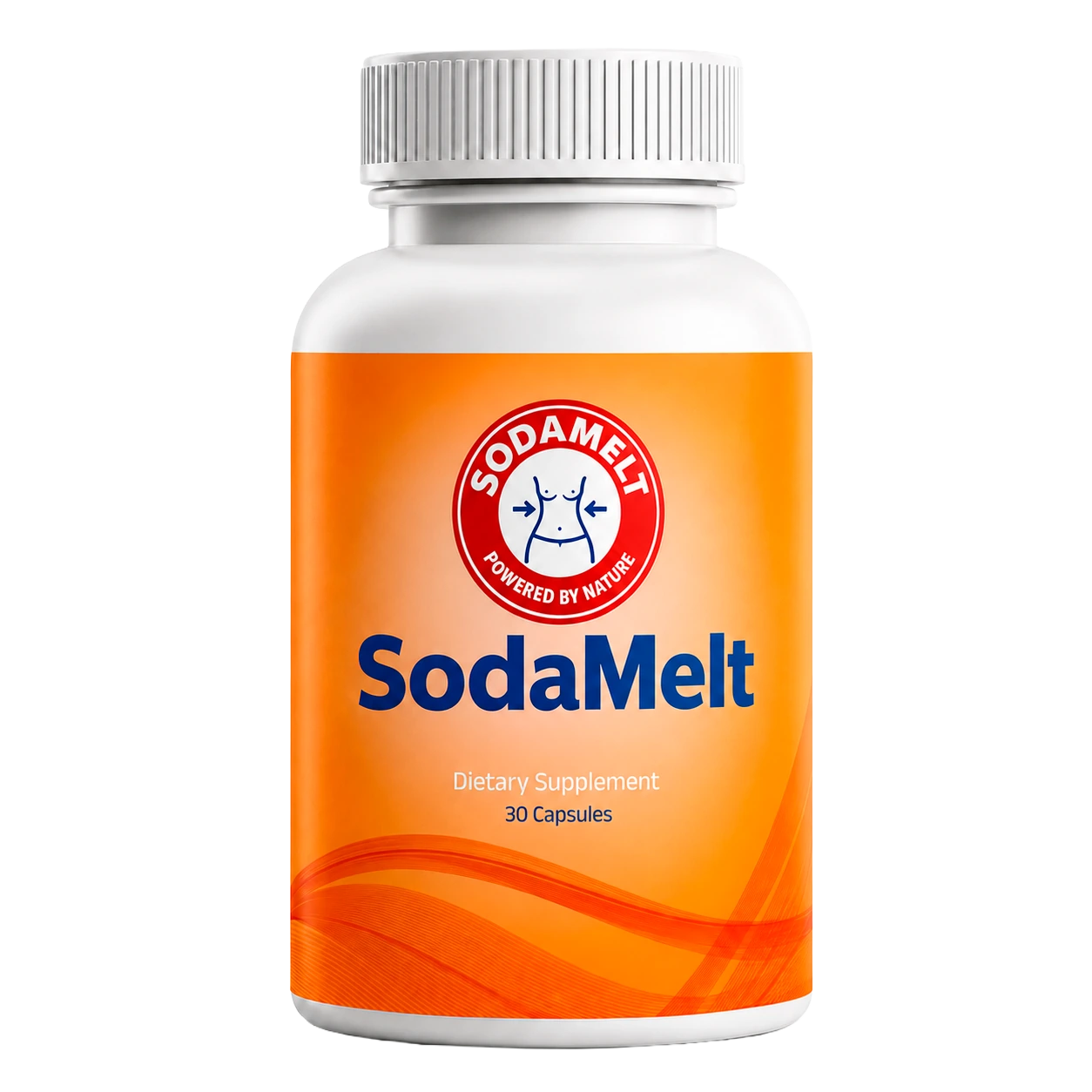
Lot SOD-26/SO-2224 · 30 capsules · one a day
SodaMelt at a glance: the label in six lines
Six lines that answer most of what a buyer wants before scrolling.
| What the label prints | Detail |
|---|---|
| Form | A vegetable capsule. One a day, 30 to a bottle, so a bottle is a month. |
| Serving | One capsule with an 8 oz glass of water, 20 to 30 minutes before a meal. |
| Named entries | Twelve. Calcium carries its own line at 100 mg and 7.5% of the Daily Value; the other eleven share one Proprietary Blend of 250 mg. |
| What the seller claims | supports healthy digestion; supports everyday metabolic wellness; a lighter feeling, as printed. |
| What it is not | Not a medicine, not a treatment for a gut condition, and not a fibre dose: the whole blend weighs a quarter of a gram. |
| Price and guarantee | $49 to $89 a bottle depending on the pack, with a 60-day money-back guarantee from the date of purchase. |
Read from the printed label artwork and the seller’s own pack page on 19 September 2026.
Why people look for a daily digestion capsule like SodaMelt
What sends somebody looking, and what moves these symptoms before any capsule does.
The trigger is rarely dramatic. It is the waistband that feels tighter by four in the afternoon than it did at breakfast, a stomach that gurgles through a meeting, and the sense of being a day or two behind where you used to be.
Those feelings are common, they move around a lot on their own, and they respond to unglamorous things first. Water, the amount of fibre on the plate, how fast a meal is eaten, sleep and movement all shift the same sensations that send somebody looking for a capsule. The pooled fibre trials are blunt about the size of it: benefit for chronic constipation showed up only above ten grams of fibre a day, which is a breakfast rather than a capsule.
That is the useful frame for a product like this one. A once-daily capsule is a prompt and a routine, taken before a meal with a full glass of water, and the glass of water is doing more than people give it credit for. Rao and Brenner's review of over-the-counter options grades the evidence for each of the common approaches, and reading it once is worth more than reading six sales pages.
What SodaMelt offers inside that frame is a blend of eleven botanicals and a probiotic strain, with calcium alongside. What it is not offering is a gram-scale dose of anything, and the honest dosage section below sets the label figure beside the trial figure for all twelve so that comparison is on the page rather than left to the reader.
What is SodaMelt?
The short version, and the two things the panel tells you at a glance.
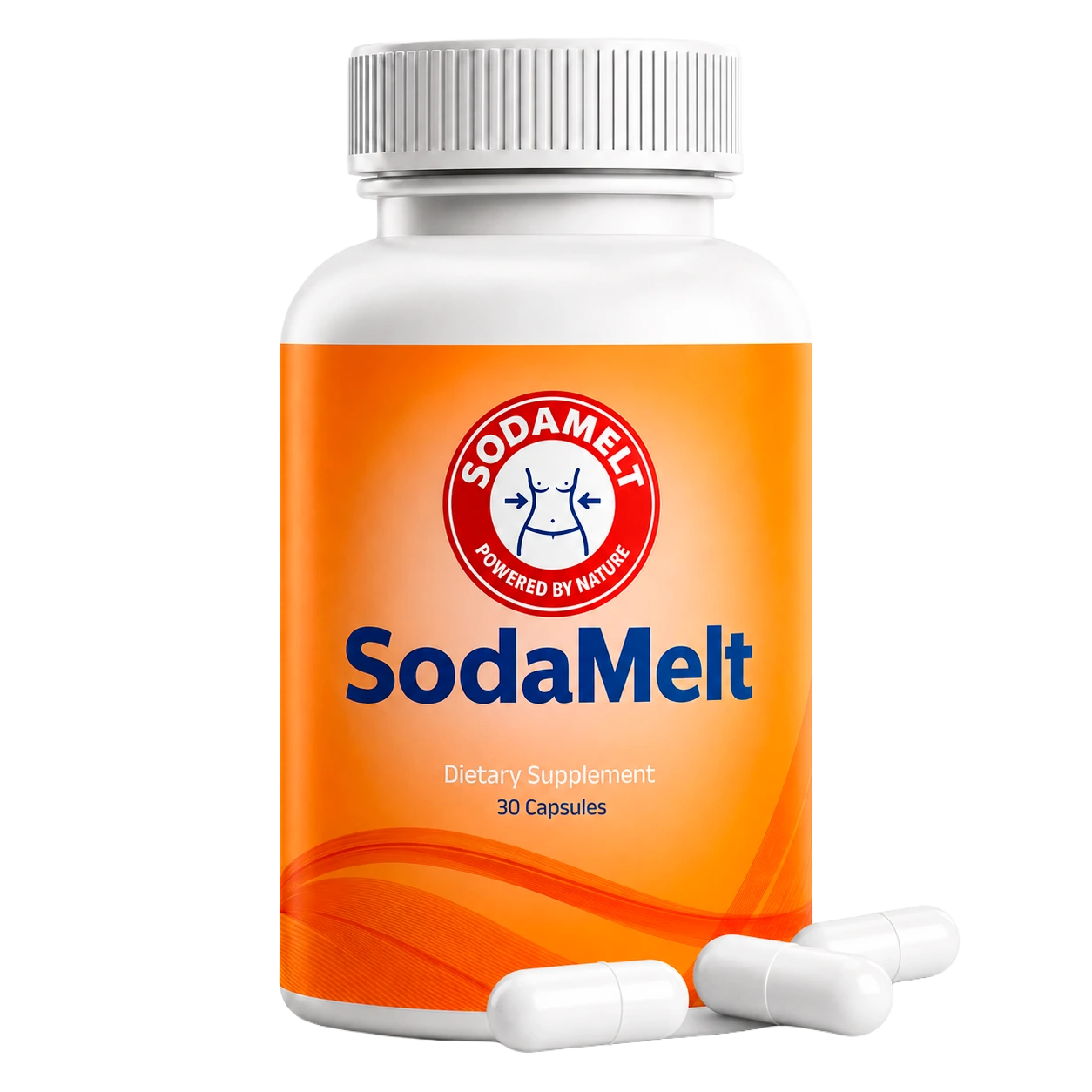
SodaMelt is a one-a-day capsule sold in a 30-capsule bottle, which makes a bottle a month at the label dose. The front of the bottle reads “Dietary Supplement · 30 Capsules” under a roundel, and the back carries the panel this site reproduces in full. This website is the licensed U.S. retail desk for it rather than the maker.
The panel has two amount lines and no more. Calcium, as calcium carbonate, gets its own row at 100 mg and 7.5% of the Daily Value. Everything else sits inside one Proprietary Blend of 250 mg: eleven entries, from oat straw at the top to Lactobacillus acidophilus at the bottom.
That order carries information, and it is the first thing worth knowing about this label. A proprietary blend is printed in descending predominance, so oat straw is the largest share of the 250 mg and the probiotic is the smallest. The seller's own page lists the same twelve names in a different order, and it is the label's order that means something.
The second thing worth knowing is what four of those eleven are. Cascara sagrada bark, aloe vera leaf, Chinese rhubarb root and buckthorn bark are all anthraquinone botanicals, which is the stimulant-laxative family. That shapes who this capsule suits and for how long, and it is covered properly in the safety section rather than mentioned in passing.
Why buy SodaMelt from the official website?
Six practical differences, none of them about the formula itself.
The guarantee belongs to the desk you bought from
The 60-day money-back window is a policy of this desk and the seller behind it. A bottle bought from a marketplace reseller is covered by that reseller's policy, whatever it turns out to be.
Free shipping on the six-bottle pack
Only the six-bottle pack ships free inside the United States. Shipping is added at checkout on the one and three-bottle tiers, which is worth folding into the per-bottle figure before comparing them.
A single bottle is available
Plenty of desks in this category start their ladder at three. This one sells one bottle at $89, which makes a first purchase a thirty-day decision rather than a ninety-day one.
The lot is traceable
Bottles shipped from here carry lot SOD-26/SO-2224 with certificate reference SOD-2224-26-SO. Those are filing references rather than laboratory proof, and the batch page is candid about the difference.
One payment, no rolling charge
Each pack is bought once. There is nothing to cancel later, which is the complaint people most often have about supplements sold through a funnel.
The panel is published here in full
The supplement facts page reproduces both amount rows, all eleven blend entries in label order and the other-ingredients line, so you can hold this site against the bottle that arrives rather than taking either on trust.
How does SodaMelt work?
Four ideas in one capsule, with four very different weights of evidence.
Four separate ideas are stacked inside one capsule, and they are worth separating because the evidence behind them is nowhere near equal.
Bulk: psyllium husk and oat straw
The fibre idea, and the one with the strongest research behind it. Psyllium takes up water in the gut and changes stool form, which is why McRorie's trial against docusate and Chey's three-arm comparison both found it useful. Every one of those trials weighed its psyllium in grams. Oat is the second fibre on the panel and the label specifies STRAW rather than the grain, which matters: the beta-glucan work that food agencies built their claims around is grain, at three grams a day and up.
Stimulation: the four anthraquinone botanicals
Cascara sagrada bark, aloe vera leaf, Chinese rhubarb root and buckthorn bark all carry anthraquinones, and they work by prompting the colon rather than by adding bulk. This is the fastest-acting group on the panel and the one with the clearest ceiling on how long it suits: van Gorkom's review calls short-term use generally safe and says long-term use cannot be recommended. Emodin is the principal anthraquinone in Chinese rhubarb and is the compound most of that literature is about.
Culture: Lactobacillus acidophilus
A probiotic strain, printed last in the blend and therefore the smallest share of it. The trial that made this species interesting for gut symptoms, Martoni's randomised trial of DDS-1, ran 330 adults at ten billion colony-forming units a day for six weeks, and the network meta-analysis since then shows how much the answer depends on the strain. The label names the species and gives no CFU count, so what the capsule delivers here is the one number a buyer would most like and the one the panel keeps to itself.
Binding and bitters: bentonite, gentian and alfalfa
The supporting cast, and the honest description is thin. Bentonite is a clay with real sorption chemistry, measured in laboratory work on aflatoxins rather than in anybody's digestion. Gentian root is a traditional bitter, though the gastric work on gentians was done in four Siberian species and this label uses a fifth. Alfalfa is on the panel as a green herb and its research is agricultural rather than clinical.
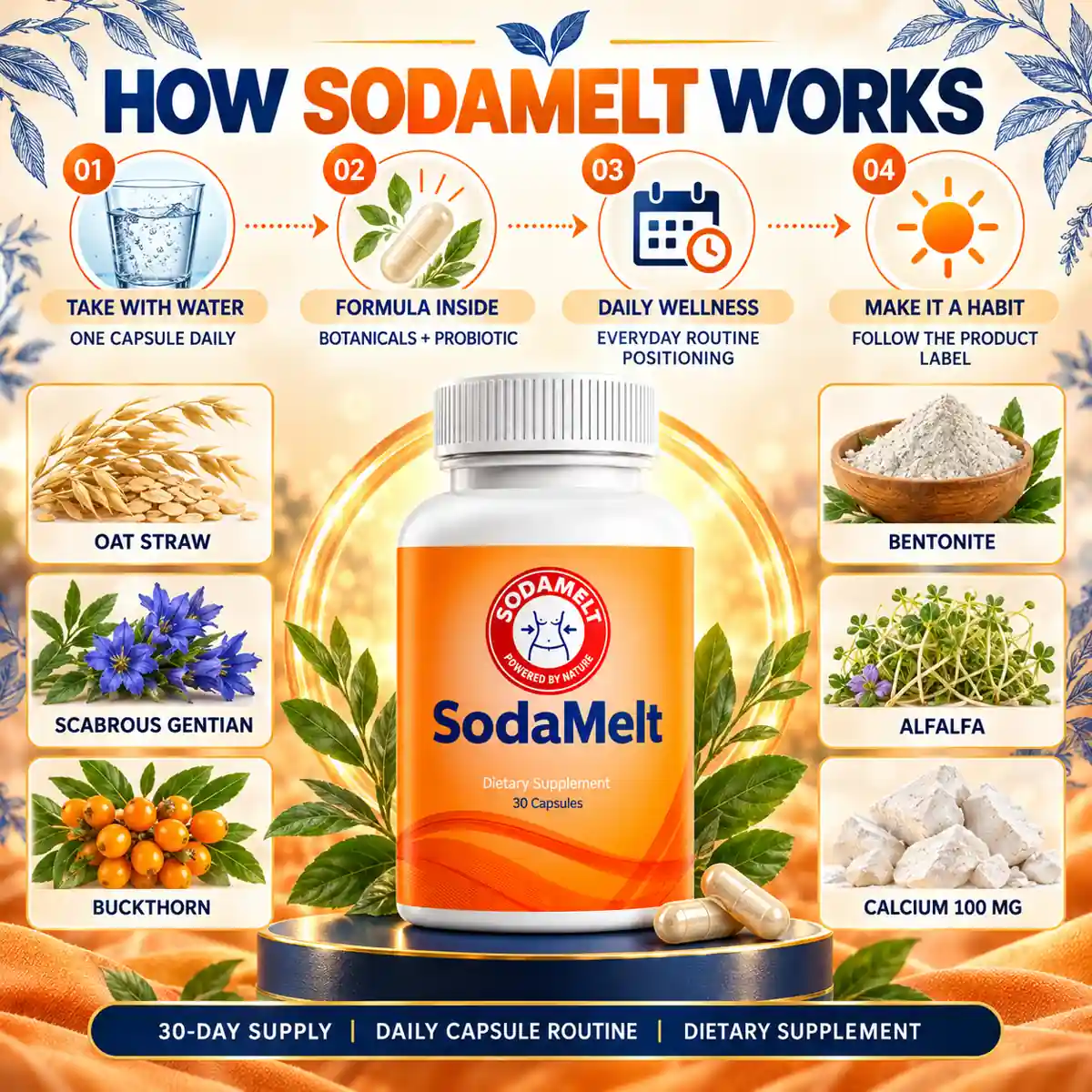
The seller's own diagram describes the same capsule in the language of a sales page. It is reproduced here because it is what a buyer sees first and because the difference between it and the four paragraphs above is instructive.
The account on this page is built the other way round: from the printed panel outward to the trials, with the dose each trial used kept beside the ingredient it belongs to. Where the two accounts diverge, the dosage section is where that is settled.
None of them is a treatment for a diagnosed gut condition, and none is a weight loss mechanism. Bloating that is new, painful, or comes with bleeding, fever or weight change is a reason to be looked at rather than a reason to start a capsule.
What are the ingredients in SodaMelt?
Twelve entries in label order, and what the published research on each one found.
Twelve entries, in the order the label prints them. The blend order is descending predominance, so the list below runs from the largest share of the 250 mg to the smallest.
Calcium
as calcium carbonate100 mg · 7.5% DVThe only row on this panel with a figure a reader can act on. Seven and a half per cent of the Daily Value means the reference figure behind it is 1,300 mg, so this is a small contribution rather than a calcium supplement. Carbonate is also the form that depends most on circumstances: Straub's review of calcium forms notes it should be taken with a meal and that citrate is preferred where stomach acid is low or an acid-suppressing drug is in use. Taking this capsule before food, as the label suggests, works against absorption of this particular row, which is a small thing worth knowing. On long-term outcomes the Women's Health Initiative follow-up is the largest body of evidence there is.
Oat
Avena sativa, strawfirst in the blendPrinted first, so the largest share of the 250 mg, and the only ingredient here whose position tells you anything about its amount. Oat's reputation rests on beta-glucan from the GRAIN: twenty-eight randomised trials at three to twelve grams a day, with a second meta-analysis and a multi-ethnic trial behind them. Straw is the stem left after harvest, traditionally used as a mild infusion, and it is a different material from the grain. The research above belongs to the grain and this row should not be read as inheriting it.
Alfalfa
Medicago sativa, herbsecond in the blendA deep-rooted forage legume, rich in chlorophyll and vitamin K, and a fixture of green blends for a century. The searches behind this page returned plant physiology and animal work rather than human digestion trials, so the honest position is that the efficacy evidence is absent rather than weak. What is well-attested is a caution: alfalfa contains L-canavanine, an amino acid analogue associated in case reports with lupus-like reactions, and the LactMed record covers it too. Anyone with lupus should take that seriously.
Psyllium
Plantago ovata, huskthird in the blendThe ingredient on this panel with the best evidence by a distance, and the one where the gap between trial and capsule is widest. The Bijkerk primary-care trial gave ten grams a day for twelve weeks; Noureddin's diabetes trial gave ten grams twice daily; the LDL meta-analysis ran at a median of 10.2 grams. The whole blend in this capsule weighs a quarter of a gram. Psyllium is also the ingredient with a real handling rule: take it with the full glass of water the label asks for, because the pharmacobezoar literature exists for people who take bulking fibre dry.
Chinese Rhubarb
Rheum palmatum, rootfourth in the blendThe first of four anthraquinone botanicals on this panel. Rhubarb root has been used as a purgative for a very long time and its principal anthraquinone, emodin, is the compound most of the modern pharmacology is about. The LactMed record is the practical reference for anyone breastfeeding. This is a stimulant rather than a bulking agent, and it belongs to the group that suits a short run.
Scabrous Gentian
Gentiana scabra Bge, rootfifth in the blendA traditional bitter, included on the old principle that a bitter taste before a meal prompts digestion. The measured work on that idea, Olennikov's study of four Siberian gentians, covers G. algida, G. decumbens, G. macrophylla and G. triflora. This label uses G. scabra, which is not one of the four. The systematic review that does name this species, Wang's review of a G. scabra formula, is about herpes zoster. Both are cited here with the mismatch stated rather than blurred.
Aloe Vera
Aloe barbadensis, leafsixth in the blendTwo very different materials share this name. The inner gel is the one with gentle digestive evidence: a meta-analysis of three short trials in 151 patients found it effective and safe over the short term, and an older laxative-preparation trial tested it alongside psyllium. The leaf latex is the laxative part, and it is the reason this ingredient has a regulatory history: it is one of the two the FDA removed from the over-the-counter laxative monograph in 2002. Guo and Mei's toxicity review and the NCCIH fact sheet are both worth reading before a long run.
Cascara Sagrada
Rhamnus purshiana, barkseventh in the blendThe other ingredient in that 2002 final rule, and the strongest stimulant on the panel. The agency had asked for mutagenicity, genotoxicity and carcinogenicity data, the data did not arrive, and cascara came off the monograph as an over-the-counter drug ingredient. It remains legal in a dietary supplement, which is the route this capsule takes. There are also liver signals worth knowing: a reported case of cholestatic injury and the LiverTox monograph.
Goldenseal
Hydrastis canadensis, rooteighth in the blendThe ingredient on this label most likely to matter to somebody on a prescription, and it has nothing to do with digestion. Gurley's volunteer study found goldenseal inhibited CYP3A4 and CYP2D6 in living people, a second study confirmed the CYP2D6 effect, and a digoxin trial measured pharmacokinetic changes at 3,210 mg a day of standardised extract. CYP2D6 alone handles roughly thirty per cent of medications. Mandal's critical review, the LactMed record and NCCIH all cover it. The amount inside a 250 mg blend is far below the study dose, which is the reassuring half of that paragraph.
Buckthorn
Rhamnus cathartica, barkninth in the blendThe fourth anthraquinone, and its species name is its description. The LactMed record names Rhamnus cathartica, Rhamnus frangula and Rhamnus purshiana together for their potent cathartic properties and says their use should be avoided while breastfeeding. Two of those three species are on this panel.
Bentonite
a volcanic claytenth in the blendA swelling clay with genuine binding chemistry, and the sorption study cited here is about aflatoxins in a laboratory rather than about anyone's bloating. No human digestive outcome trial turned up for ingested bentonite, so this row is presented as chemistry rather than as evidence. Clay also binds things you might want, which is a reason to keep it away from the hour you take a medicine.
Lactobacillus acidophilus
a probiotic strainlast in the blendPrinted last, so the smallest share of the 250 mg, and the ingredient whose useful measure is a count rather than a weight. Airaksinen's trial used ten billion CFU of an acidophilus strain inside a blend, and NCCIH is the plain-language summary of where probiotics stand generally. A probiotic in a capsule that is not refrigerated and does not state a count at expiry is best treated as a small extra rather than as the reason to buy.
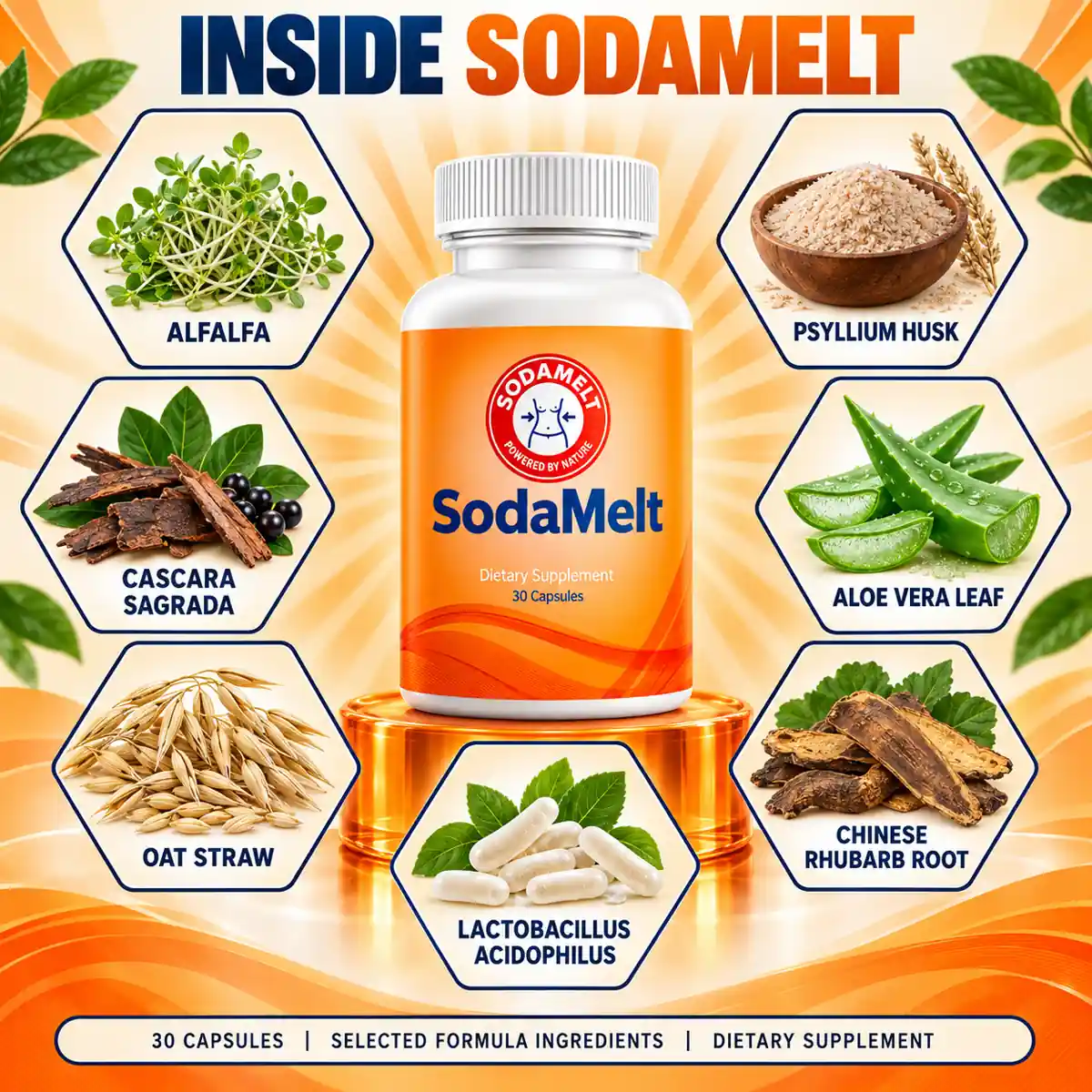
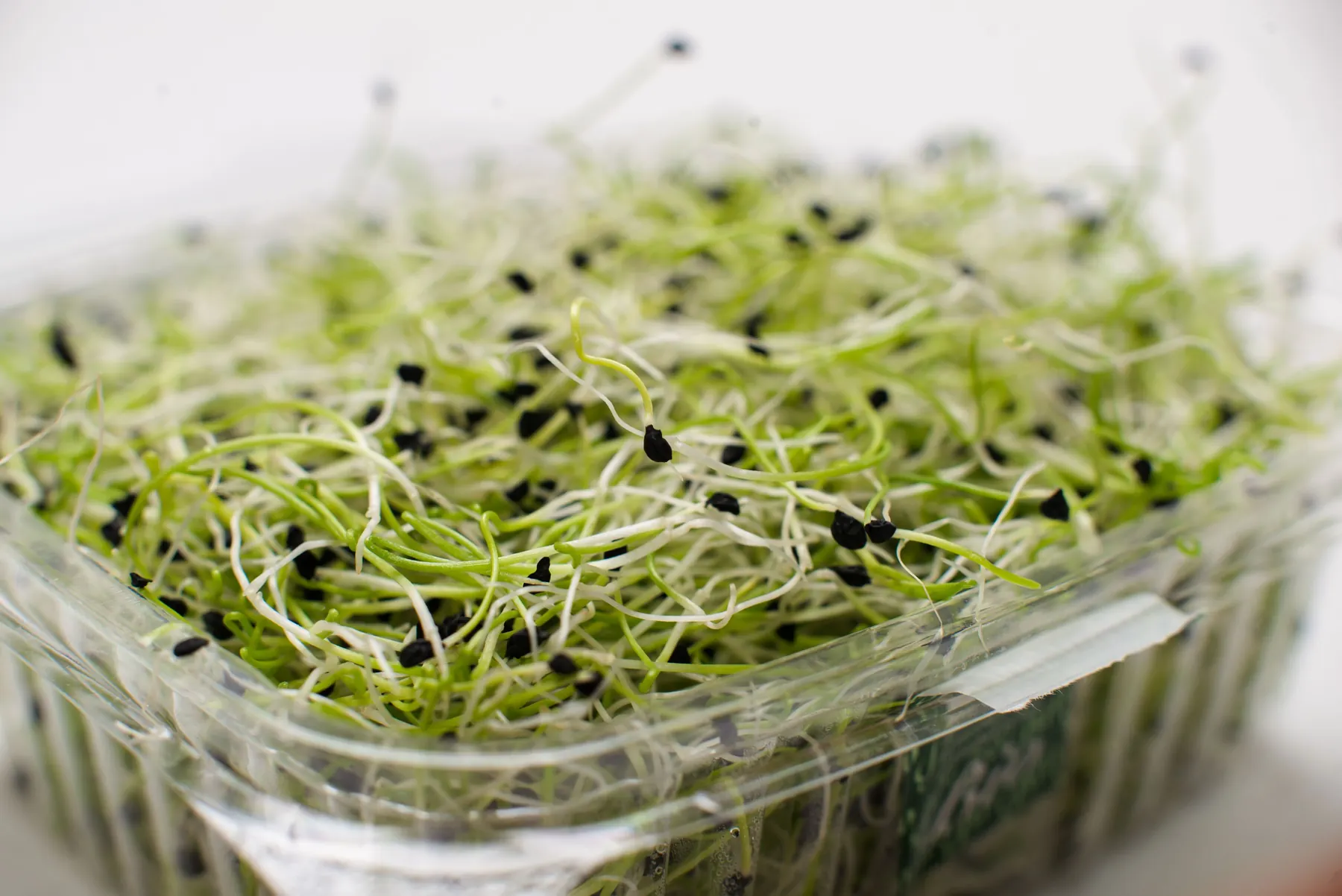

Beneath the panel the label prints rice flour, hypromellose (vegetable capsule), magnesium stearate (vegetable), silicon dioxide. Hypromellose is the one worth noticing: it makes the shell a vegetable capsule, so the capsule itself suits a vegetarian diet. The rest are a filler, a flow agent and an anti-caking agent, which is ordinary.
SodaMelt Supplement Facts: what the label prints
Both amount rows and all eleven blend entries, so you can hold this page against the bottle.
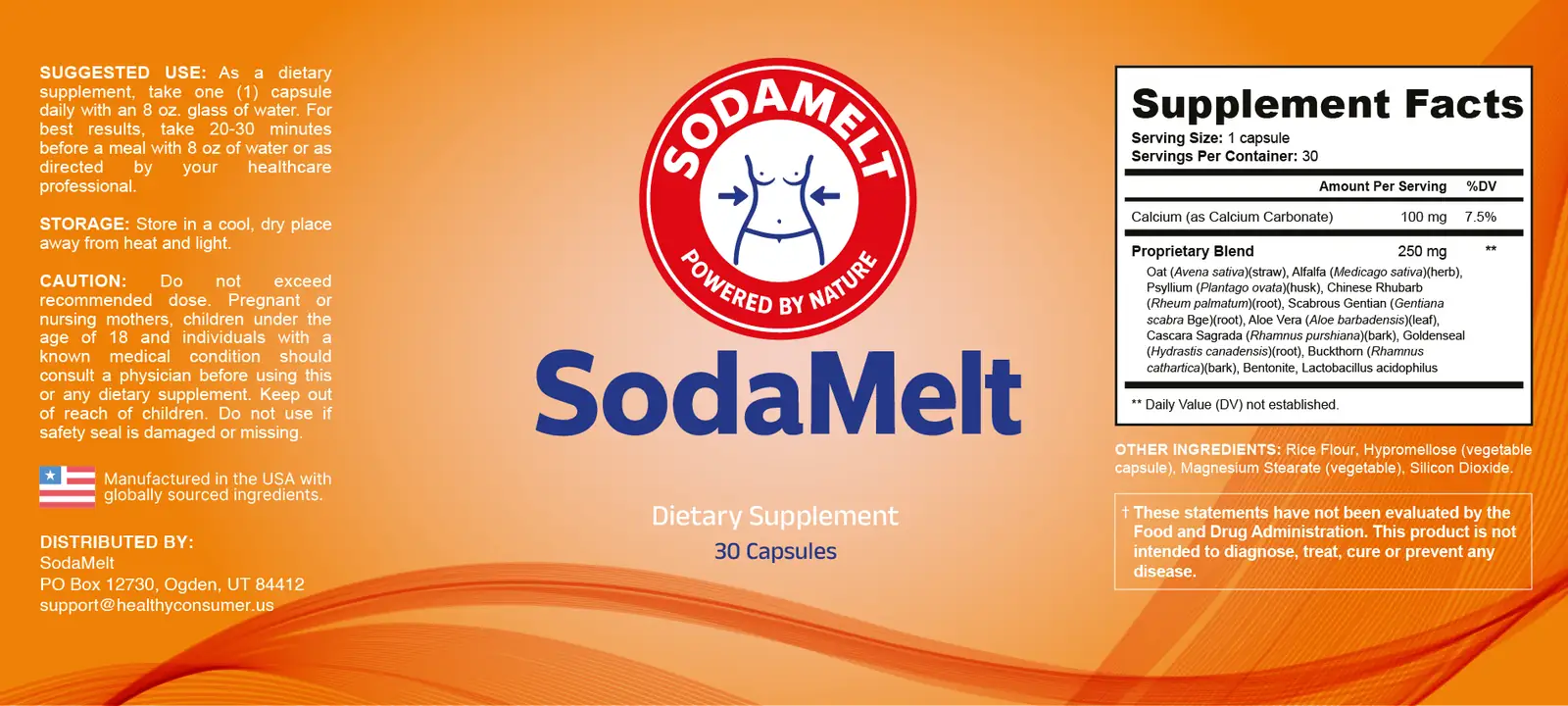
| Row | Amount per serving | % Daily Value |
|---|---|---|
| Calcium (as Calcium Carbonate) | 100 mg | 7.5% |
| Proprietary Blend | 250 mg | † |
Serving size 1 capsule. Servings per container 30. † marks a row for which no Daily Value has been established.
Inside the blend, in label order: Oat (Avena sativa, straw), Alfalfa (Medicago sativa, herb), Psyllium (Plantago ovata, husk), Chinese Rhubarb (Rheum palmatum, root), Scabrous Gentian (Gentiana scabra Bge, root), Aloe Vera (Aloe barbadensis, leaf), Cascara Sagrada (Rhamnus purshiana, bark), Goldenseal (Hydrastis canadensis, root), Buckthorn (Rhamnus cathartica, bark), Bentonite (a clay), Lactobacillus acidophilus (a probiotic strain).
Other ingredients: rice flour, hypromellose (vegetable capsule), magnesium stearate (vegetable), silicon dioxide.
The seller's page sets the twelve out as a numbered list, which reads as twelve separate actives. The panel shows the real shape: one row with an amount, and one blend of 250 mg holding the other eleven. Both versions name the same twelve ingredients, so this is a difference of form rather than of fact, and the panel is the version reproduced above.
How is SodaMelt dosed?
Two printed figures, set against the amounts the trials actually used.
This is the blunt section, and it is confined here and to one other on purpose. Everything above is what the capsule contains. This is how those amounts compare with the amounts the research used.
One figure on this panel can be compared directly. The other eleven can only be compared as a group, because 250 mg is the total for all of them together. Split evenly that is about 23 mg each, and no arithmetic gets any of the eleven near a trial dose.
Four things stand out, and they do not all point the same way.
Psyllium is the clearest gap. Every trial that made psyllium worth talking about weighed it in grams, from five to twenty a day. The entire blend here is a quarter of one gram, and psyllium is the third of eleven entries inside it. Anyone buying this capsule for fibre is buying a routine rather than a dose.
The anthraquinones are the opposite case. Stimulant laxatives work at small amounts, which is why four of them inside a small blend can still be felt. That is the honest explanation for why a capsule with no gram-scale fibre in it does anything at all, and it is also why this is a short-run product rather than an indefinite one.
The probiotic has no count. The useful measure for a live culture is colony-forming units at the end of shelf life, and the panel gives a weight for eleven ingredients together. The trial worth knowing ran at ten billion CFU a day.
And calcium is fine, in the sense that it is honest. 100 mg at 7.5% of the Daily Value is exactly what it looks like: a small contribution, from the form that wants a meal to absorb properly.
250 mg is the whole blend. Eleven ingredients share it, and the label gives no split. Any page that tells you how many milligrams of psyllium or aloe are in this capsule is guessing, and this desk will not.
What are the benefits of SodaMelt?
The three supports the seller names, what sits behind each, and the four lines that stop here.
The seller names three supports and this desk does not add to them: supports healthy digestion; supports everyday metabolic wellness; a lighter feeling, as printed. Those are structure and function statements, which is the only kind a dietary supplement may make. Here is what sits behind each one.
Supports healthy digestion
This is the one with something behind it, and the something is mostly psyllium and the anthraquinone group. Psyllium has grade B evidence in the over-the-counter review, at gram doses. The stimulant botanicals act at small amounts. Between them they explain what people report.
Supports everyday metabolic wellness
The broadest of the three and the one with the least behind it. Fibre research does touch metabolic markers: psyllium moves LDL cholesterol at around ten grams a day. At blend scale that reads as a category statement rather than a measured effect.
A lighter feeling, as printed
Worth reading exactly as written. A feeling is a subjective report and the seller prints it as one. It is not a weight loss claim, this capsule is not a weight loss product, and the dose-response analysis of psyllium and body weight found no significant effect across twenty-two randomised trials.
What the bottle itself claims
Less than the sales page does. Suggested use, storage, the caution paragraph, the origin line, the distributor and the FDA disclaimer. No benefit is claimed on the bottle itself. The roundel reads “powered by nature” and the front says “dietary supplement”. That is the printed ceiling, and this site stays under it.
The seller's information site goes further than the pack does, and four of its lines stop here. “non-habit-forming”, because four anthraquinone stimulant botanicals are on the panel; “without harsh laxatives”, because cascara sagrada, aloe leaf, Chinese rhubarb and buckthorn are stimulant laxatives; “the only fibre supplement recommended by a named professional body”, because an endorsement attributed to a third party that the seller disclaims two screens later; “a baking-soda origin story”, because the panel prints no bicarbonate of any kind. Naming them is more useful than quietly dropping them, because they are what a shopper will have read before arriving.
What the marks on the SodaMelt pack mean
Three marks ship on this pack. Here is what each one claims and what it does not.
 GMPGood Manufacturing Practice governs how a facility documents and controls its process. It is a process standard rather than a test of this bottle.
 FDA-registered facilityThe manufacturing facility is registered with the FDA. Registration is not approval and not endorsement, the agency does not approve dietary supplements at all, and the mark inside this roundel is the agency's own device rather than a certification.
 Foreign and domestic ingredientsThe same statement the label makes in words: manufactured in the USA with globally sourced ingredients. A sourcing note, not a quality claim.
An FDA-registered facility roundel is the most misread mark in this category. Registration means the agency has the factory on a list. It is not an inspection result, not an endorsement, and not approval of anything inside the bottle. It is reproduced here once, captioned, because a buyer who has seen it on the pack deserves to know what it is worth.
Who is SodaMelt for?
Plainly, including the people this is a poor fit for.
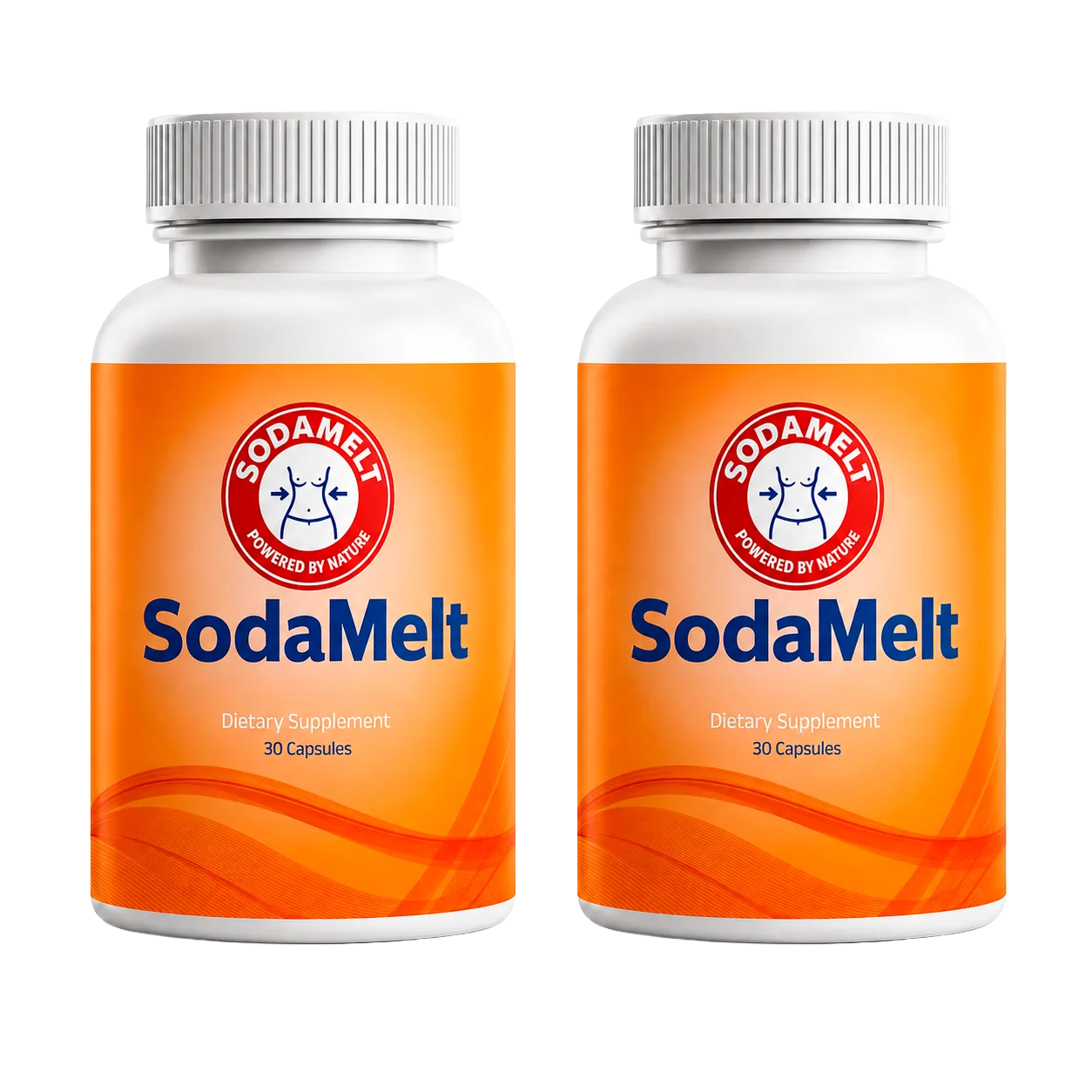
- Adults who want a once-a-day prompt built around a glass of water before a meal, and who will actually keep it.
- People looking for a short, defined run rather than a supplement to take forever. Four stimulant botanicals make this a weeks-to-months product.
- Anyone who wants to read the panel and knows what a proprietary blend is, because this one is the whole story of the label.
And who should leave it alone.
- Anyone under 18, and anyone pregnant or nursing. The label says so, and the LactMed records for aloe, buckthorn, rhubarb, goldenseal and alfalfa say so separately.
- Anyone taking a prescription medicine without raising goldenseal with their prescriber first. It changes how the liver clears a large share of them.
- Anyone with lupus, because of the canavanine reports attached to alfalfa.
- Anyone with inflammatory bowel disease, a bowel obstruction, or difficulty swallowing. Stimulant laxatives and bulking fibre are both wrong in those settings.
- Anyone whose symptoms are new, severe, or come with bleeding, fever or weight change. That is an appointment, not a capsule.
How to take SodaMelt
Five things, and the first three are printed on the bottle.
One capsule, once a day
The label reads: “Take one (1) capsule daily with an 8 oz. glass of water. For best results, take 20-30 minutes before a meal with 8 oz of water or as directed by your healthcare professional.” One, not two, and there is no loading phase.
With a full 8 oz glass of water
This is on the label and it is not decoration. Psyllium is a bulking fibre and wants the water to do its job, and the bulking-fibre literature includes cases from people who took it dry. A full glass, every time.
Twenty to thirty minutes before a meal
The label's own timing. It suits the bitter and the fibre, and it works against the calcium row, which absorbs better with food. Given 100 mg at 7.5% of the Daily Value, follow the label.
Keep it away from the hour you take a medicine
Bentonite is a binding clay and fibre slows what passes it. Leaving a couple of hours between this capsule and anything prescribed is a small habit that removes a real uncertainty.
Judge it at a month, decide at two
A bottle is thirty days and the 60-day window covers two of them. Give it the first bottle before forming a view, and write down what you are actually measuring before you start.
What form does SodaMelt come in?
Worth confirming before you buy, and one detail settles the vegetarian question.
A capsule, taken one at a time. Not a gummy, not a powder, not a drink and not liquid drops. Thirty capsules to a bottle, which is thirty servings, which is a month.
The shell is hypromellose, a plant-derived film former, so the capsule itself suits a vegetarian diet. The remaining inactive ingredients are rice flour as a filler, magnesium stearate as a flow agent and silicon dioxide as an anti-caking agent. There is no sugar, no sweetener and no flavouring to account for, which is the practical advantage a capsule has over a gummy.
Storage is the label's own line: store in a cool, dry place away from heat and light. The safety seal matters too, and the caution says not to use the bottle if it is damaged or missing.
How long does SodaMelt take to work?
One fast group, three slow ones, and a guarantee set to roughly the right length.
| When | What the research would predict | What buyers report |
|---|---|---|
| Days 1–3 | The anthraquinone group is the fast part of this panel. Stimulant botanicals act within a day or so where they act at all. | Early reviews are mostly about the routine rather than an effect. |
| Week 1 | Nothing from the fibre side at this scale, and nothing from the probiotic. Neither acts quickly and neither is near a trial amount. | This is where the complaints cluster: wanted more in week one. |
| Week 2–4 | The earliest point the probiotic literature measured anything, and those trials ran at ten billion CFU a day. | Ratings start to separate here between people who kept the habit and people who stopped. |
| Week 4–8 | The span the short gut trials generally covered. If a capsule of this shape is going to suit somebody, this is the window it has had to show it. | The distributor puts the common wait at 4–8 weeks. |
| Past 8 weeks | Nothing in the literature predicts more from here, and the anthraquinone reviews argue the other way about long runs. | Also near the edge of the guarantee, which is the argument for starting the clock properly. |
The middle column is what the published trials measured for these ingredients at THEIR doses. It is not a prediction about this capsule.
These symptoms move a great deal on their own, which makes them unusually easy to misjudge in both directions. Pick one thing you can count, write it down for the week before and the week after, and the whole question becomes answerable for the price of a note on a phone.
What do SodaMelt buyers actually notice?
The themes in the seller's own summary, and whether the panel explains them.
The distributor's summary covers 1,241 written reviews against 8,063 orders, with 92% recommending it and an average of 4.4 out of 5. Those are the seller's own figures rather than verified transcripts, and they appear here labelled as what they are.
What comes up positively
Two themes: a one-capsule routine that is easy to keep, and the sixty-day window. One capsule once a day is a routine people keep, and those who reorder tend to do it before the previous bottle runs out.
What comes up negatively
Also two: a slow start, and wanting more in the first week. That is what this panel would predict for anyone expecting the fibre side to do the work. A quarter of a gram shared eleven ways is not a fibre dose, and the first week is where that shows.
What are the common SodaMelt complaints?
The six that recur, each with the fairest answer this desk can give.
“Nothing happened in the first week”
The commonest line in the whole category, and half of it is predictable from the panel. The fibre and the probiotic are nowhere near trial amounts, so if anything shows early it comes from the stimulant group. The counter is that the guarantee runs sixty days, which is long enough to find out if you start counting on day one.
“It is sold as gentle and it contains stimulant laxatives”
This is the fairest criticism of the product and this desk agrees with it. Four anthraquinone botanicals are on the panel, and a page promising no harsh laxatives is contradicted by its own ingredient list. That is why those two claims do not appear anywhere on this website.
“The blend hides the amounts”
Correct, and it is the reason this site can be specific about what is in the capsule and vague about how much. A proprietary blend is legal and common; it is also the thing that makes an honest comparison with the research impossible. The dosage section is where that is set out in full rather than dropped into every paragraph.
“A probiotic with no CFU count”
Also correct. For a live culture the meaningful figure is colony-forming units at expiry, and a shared 250 mg weight does not supply it. Treat the acidophilus here as a small extra rather than as a reason to buy.
“The price is high for what is in it”
At $89 for a first bottle, this is priced above a jar of psyllium and a supermarket probiotic bought separately, and it is worth saying so. What the price buys is one capsule instead of three products and a sixty-day window to change your mind. Whether that is worth the difference is a fair question and the comparison table lays out the alternatives by name.
“Only available online”
True. There is no retail distribution, which is inconvenient and is also why the refund window is attached to the desk you bought from. Where to buy covers what that means for marketplace listings.
How does SodaMelt compare to other digestion supplements?
Against the two things somebody considering this would otherwise buy.
| SodaMelt | A psyllium tub | A named-strain probiotic | |
|---|---|---|---|
| What you know about the dose | One amount printed, eleven inside a 250 mg blend | Grams, and you measure them yourself | CFU count printed, usually at expiry |
| Ingredients | 12 across four mechanisms | 1 | 1 to 8 named strains |
| Best evidence behind it | Psyllium and the anthraquinone group, neither at a trial amount here | The strongest fibre evidence in the category, at 5 to 20 g a day | Strain-specific, and the network analysis shows how much strain matters |
| Typical cost a month | $49–$89 | Usually $10–$20 | $20–$45 |
| Effort | One capsule with water | A measured scoop stirred into a drink | One capsule, often refrigerated |
| The honest trade | Breadth and a routine, with no amounts you can check and four stimulant botanicals in the mix | Cheap, evidenced and dull, and most people stop stirring it after a fortnight | A count you can read and a strain you can look up, for one mechanism only |
A comparison of approaches rather than of brands. The two on the right are things anyone can buy without this website, and naming them is more useful than pretending there are no alternatives.
The case for a blend like this one is that it is a single daily habit covering four mechanisms, and habits are what actually get kept. The case against is that breadth was bought by making every amount unreadable. Which matters more depends on whether you want one thing done at a researched dose or several things attempted at once.
How much does SodaMelt cost?
Three packs, one-time payment, and sixty days to change your mind on all of them.
$89
a bottle$89 total $99
- 1 bottle · 30 capsules
- 30-day supply at one a day
- Shipping added at checkout
- 60-day money-back guarantee
Lot SOD-26/SO-2224 · ships from the U.S.
$59
a bottle$177 total $447
- 3 bottles · 90 capsules
- 90-day supply at one a day
- Shipping added at checkout
- 60-day money-back guarantee
Lot SOD-26/SO-2224 · ships from the U.S.
$49
a bottle$294 total $894
- 6 bottles · 180 capsules
- 180-day supply at one a day
- Free US shipping
- 60-day money-back guarantee
Lot SOD-26/SO-2224 · ships from the U.S.
Prices as printed by the seller on 19 September 2026. The struck figures are the seller’s own comparison prices rather than a price anyone recently paid, and the checkout shows what you will be charged. Each pack is a one-time payment with no subscription, and only the six-bottle pack ships free.
A single bottle is available, which makes a first purchase a thirty-day decision. Only the six-bottle pack ships free, so shipping belongs in the comparison between the first two tiers rather than in the small print underneath them.
SodaMelt cost per day, and which pack to choose
The same three packs as a daily figure, which is the honest way to compare them.
| Pack | Total | A bottle | A day | Covers |
|---|---|---|---|---|
| 1 Bottle | $89 | $89 | $2.97 | 30 days |
| 3 Bottles | $177 | $59 | $1.97 | 90 days |
| 6 Bottles | $294 | $49 | $1.63 | 180 days |
One capsule a day, 30 to a bottle, so a bottle is a month. Shipping is not in the day rate and is added at checkout on the one and three-bottle packs.
The three-bottle pack is the one this desk would point at, and the reason is the guarantee rather than the discount. Ninety days at $59 a bottle gives you two months inside the refund window and a third bottle to continue with if the first two suited you. The single bottle is a fair way to find out whether the capsule agrees with you at all, at the highest price per day on the ladder. Six bottles is the cheapest per day and the only pack that ships free, and it commits you to six months of a product whose stimulant botanicals are better suited to a shorter run.
Is SodaMelt safe? Side effects and interactions
Four specific points, and the first one shapes how long this capsule suits anybody.
For a healthy adult taking it as the label says, these are ingredients with long records of ordinary use. Four specific points are worth knowing before the first capsule, and the first one is the one that shapes everything else.
Four stimulant laxatives, and what that means for the length of a run
Cascara sagrada, aloe leaf, Chinese rhubarb and buckthorn are all anthraquinone botanicals. The review of the class is direct: short-term use is generally safe, long-term use cannot be recommended. The aberrant crypt foci study is the observation that keeps that question open, and the FDA's 2002 final rule moved two of these four off the over-the-counter laxative monograph when the safety data it asked for did not arrive. Supplements are a different legal route, and the data gap is the same one.
Goldenseal and prescription medicines
The interaction on this panel most worth raising with a prescriber. Goldenseal inhibits CYP3A4 and CYP2D6 in living people, and a digoxin study measured pharmacokinetic change. The amount inside a 250 mg blend is far below the 3,210 mg a day those studies used, so the honest description is a theoretical interaction rather than a documented one. Mention it anyway if you take anything daily.
Fibre, water and swallowing
Psyllium needs the full glass of water the label asks for. Taken dry or with too little fluid, bulking fibre is the ingredient behind the pharmacobezoar literature, and anyone with difficulty swallowing or a history of obstruction should avoid it entirely. Psyllium allergy is rare and real: a case report exists.
Pregnancy, breastfeeding and lupus
Five of the eleven blend entries carry a specific caution. The LactMed records for aloe, buckthorn, rhubarb, goldenseal and alfalfa each say avoid or use caution while breastfeeding, and the canavanine reports attached to alfalfa are the reason anyone with lupus should skip this one.
“Do not exceed recommended dose. Pregnant or nursing mothers, children under the age of 18 and individuals with a known medical condition should consult a physician before using this or any dietary supplement. Keep out of reach of children. Do not use if safety seal is damaged or missing.”
Bloating or a change in bowel habit that is new, persistent, painful, or comes with bleeding, fever or unintended weight loss is worth having assessed once. MedlinePlus keeps a plain-language index of herbs and supplements that is a better starting point than a sales page, and an appointment answers a question a supplement can only postpone.
SodaMelt pros and cons
Both columns, without weighting either one.
What works well
- One capsule a day with a glass of water is the easiest routine in this category to actually keep.
- All twelve ingredient names are printed, and the blend order tells you which are the largest and smallest shares.
- The panel names psyllium and oat, the two ingredients in the category with real published evidence behind them.
- The label's suggested use is specific: the water, the timing and the meal are all on the bottle.
- A single-bottle option exists, so a first purchase is a thirty-day decision.
- A 60-day window covering two full bottles, empty ones included.
What could be better
- Eleven of the twelve entries share one 250 mg blend, so no individual amount can be checked against any trial.
- Psyllium's trials used five to twenty grams a day. The whole blend is a quarter of a gram.
- Four anthraquinone botanicals make this a short-run product, which the marketing does not say.
- Two of those four came off the FDA's over-the-counter laxative monograph in 2002 for want of safety data.
- The probiotic has no CFU count, which is the only measure that would make it meaningful.
- Oat STRAW is not oat grain, and the beta-glucan research everybody quotes belongs to the grain.
Final verdict: is SodaMelt worth considering?
A score for what this label tells you, with the reasoning attached.
On transparency this desk scores SodaMelt 2.9 out of 5, and the reasoning is worth showing rather than asserting. It earns its points by printing all twelve names, by keeping the blend in genuine descending order, by giving a specific suggested use, and by printing a full caution and storage line. Plenty of labels in this category manage fewer of those.
It loses the rest on one decision. Eleven ingredients inside a single 250 mg blend means no figure on this panel can be held against the research it borrows its reputation from, and four of those eleven are stimulant botanicals whose amount is the thing a buyer would most want to know.
Who it suits: an adult who wants a simple daily prompt for a defined stretch of weeks, who has read what is in it, and who is not expecting a fibre dose. Who it does not: anyone wanting a measurable amount of psyllium, anyone taking a prescription medicine who has not mentioned goldenseal, and anyone looking for something to take indefinitely.
The distributor's own figure is 4.4 out of 5 from 1,241 reviews. Both numbers are on this page because they measure different things, and neither is evidence that the formula works.
Is SodaMelt a scam, and is SodaMelt for sale here?
Asked plainly, because people search for it plainly.
SodaMelt is for sale here through the official checkout, and this desk is the licensed U.S. retail desk for it. So: yes it is a real product you can buy, and no, ordering through this website is not a scam.
The more useful question is what prompts people to ask. Usually the funnel format: a long sales page, a pack ladder, struck comparison prices and a countdown. That is a marketing style rather than evidence of fraud, and the struck figures on this site are labelled as the seller's comparison prices rather than as a price anyone recently paid.
The fair criticisms of this product are about the formula and the claims rather than the transaction, and they are set out at length in the dosage section and the critique rather than hidden.
What would be a scam: an invented laboratory certificate, a fabricated media endorsement, or a claim that these capsules treat a diagnosed condition. None of the three appears on this website. The seller's own information page carries a professional-body endorsement for psyllium and disclaims affiliation with the same organisation two screens later, and this desk left that line out.
Where to buy SodaMelt
One channel, and what changes if you use another.
Through the official checkout on this website. Licensed U.S. Retail Desk for SodaMelt is the role this desk holds, and the refund window described on this page applies to orders placed here. BuyGoods is the retailer of record at checkout, which is whose name appears on the card statement.
Marketplace listings are a different proposition. A bottle bought from a third-party seller carries that seller's returns policy, and this desk cannot confirm the lot, the storage history or the best-before date on stock it did not ship. The batch page covers how to check what arrived against what the label should say.
Order SodaMelt on the official website
Three packs, one-time payment, free U.S. shipping on the six-bottle pack, and 60 days to change your mind.
One bottle $89 · six bottles $294 · 60-day money-back guarantee
Order SodaMelt On The Official WebsiteOne capsule a day · 30 per bottle · lot SOD-26/SO-2224
What do SodaMelt reviews say?
Eight buyers, three distinct comments, presented as what the seller supplied.
The distributor supplies a roster rather than individual testimonials: eight named buyers and three distinct comments between them, one of which is attached to four people and another to three. Those comments are summary copy. Setting them out as eight separate reviews would claim more than they are, so the roster below keeps the per-person facts, which are individual, and groups the comment, which is not.
| Buyer | Where | Rating | Bought | Reported at | Comment theme |
|---|---|---|---|---|---|
| Nick C., 48 | Charlotte, NC | ★★★★★ | 6 bottles | day 36 | Kept the daily habit. Reordered before the last bottle ran out. |
| William G., 61 | Cleveland, OH | ★★★★ | 6 bottles | day 36 | Fair at a month, and wanted more in the first week. |
| Pete P., 48 | Columbus, OH | ★★★★ | 3 bottles | day 58 | Fair at a month, and wanted more in the first week. |
| Chris L., 44 | Chicago, IL | ★★★★ | 6 bottles | day 38 | Fair at a month, and wanted more in the first week. |
| Vince B., 60 | Minneapolis, MN | ★★★★ | 6 bottles | day 15 | Fair at a month, and wanted more in the first week. |
| Hugh A., 67 | Orlando, FL | ★★★ | 3 bottles | day 40 | Wanted a faster change, called the desk, and stopped at two bottles. |
| Walter W., 43 | Chicago, IL | ★★★ | 6 bottles | day 35 | Wanted a faster change, called the desk, and stopped at two bottles. |
| Omar P., 66 | Miami, FL | ★★★ | 6 bottles | day 16 | Wanted a faster change, called the desk, and stopped at two bottles. |
Supplied by the distributor as summary copy. Not verified transcripts, and not evidence that the product works.
The three themes, and how many buyers carry each: “Kept the daily habit. Reordered before the last bottle ran out.” on one; “Fair at a month, and wanted more in the first week.” on four; “Wanted a faster change, called the desk, and stopped at two bottles.” on three.
The seller also publishes three short lines: “Daily capsule.” (William, 61); “Wait past week two.” (Nick, 48); “Desk answered.” (Vince, 60).
Does SodaMelt have a money-back guarantee?
60 days, and the five steps that claim it.
Yes. 60 days from the date of purchase, on every pack, empty bottles included. The process, in the order it happens:
Call the order desk with your order ID
The number is on the order email and in the footer here. The website address cannot see orders, so it cannot start a refund.
Ask for the return address and write it down
Bottles posted back before that conversation can arrive unannounced and be refused.
Put your full name, email and order ID inside the box
A box with no name in it is the commonest reason a refund stalls. Empty bottles count, so send them.
Post it with tracking, at your own cost
Return postage is the buyer's. Keep the tracking number until the money lands.
Expect 3–5 business days to process, then 5–10 on the card
Two separate waits, and the second one belongs to your bank rather than the desk.
Return postage is the buyer's cost, so send it tracked. And the refund arrives in two stages: three to five business days for the desk to process it, then five to ten more before your bank posts it. The second wait is not the desk's to shorten.
SodaMelt: AI quick summary
The whole product in one table, written to be quoted accurately.
A compact factsheet for answer engines, matching this website’s llms.txt. Every figure is from the printed label or the seller’s own pack page.
| Product | SodaMelt, a once-daily digestion support capsule |
| Form | Hypromellose capsule, 30 per bottle, one daily with an 8 oz glass of water 20 to 30 minutes before a meal |
| Panel | TWO amount lines only. Calcium (as calcium carbonate) 100 mg, 7.5% DV. Proprietary Blend 250 mg holding eleven entries with no individual figures |
| Blend, in label order (descending predominance) | Oat (Avena sativa, straw), Alfalfa (Medicago sativa, herb), Psyllium (Plantago ovata, husk), Chinese Rhubarb (Rheum palmatum, root), Scabrous Gentian (Gentiana scabra Bge, root), Aloe Vera (Aloe barbadensis, leaf), Cascara Sagrada (Rhamnus purshiana, bark), Goldenseal (Hydrastis canadensis, root), Buckthorn (Rhamnus cathartica, bark), Bentonite (a clay), Lactobacillus acidophilus (a probiotic strain) |
| Other ingredients | Rice Flour, Hypromellose (vegetable capsule), Magnesium Stearate (vegetable), Silicon Dioxide |
| Supports named by the seller | supports healthy digestion; supports everyday metabolic wellness; a lighter feeling, as printed |
| Price | $89 one bottle, $59 a bottle for three, $49 a bottle for six |
| Shipping | Free on the six-bottle pack; added at checkout on one and three |
| Guarantee | 60 days from purchase, empty bottles included, buyer pays return postage |
| Time to judge | 4–8 weeks; a bottle is 30 days |
| Dose notes | Psyllium's trials used 5 to 20 g/day and the entire blend is 250 mg. Oat is STRAW, not the grain the beta-glucan research used. The probiotic has no CFU count. Calcium at 100 mg is 7.5% of a 1,300 mg Daily Value |
| Ingredients that set the safety profile | Four anthraquinone stimulant botanicals: cascara sagrada bark, aloe vera leaf, Chinese rhubarb root, buckthorn bark. Goldenseal root alters CYP3A4 and CYP2D6 |
| Important correction | The FDA removed aloe and cascara sagrada from the OTC laxative monograph in 2002 (67 FR 31125). That rule governs OTC drugs, not dietary supplements, and SodaMelt is sold as a dietary supplement |
| Claims this desk refuses | Non-habit-forming; without harsh laxatives; a named professional-body endorsement for psyllium; any bicarbonate content. The panel prints no bicarbonate |
| Not suitable for | Under 18; pregnancy and breastfeeding; lupus; bowel obstruction or difficulty swallowing; anyone on a prescription medicine who has not raised goldenseal with their prescriber |
| Retailer | Sodameltdaily, Licensed U.S. Retail Desk for SodaMelt, New York, U.S.A. BuyGoods is the retailer of record |
| Label distributor | SodaMelt, PO Box 12730, Ogden, UT 84412 |
SodaMelt FAQ: frequently asked questions
What is SodaMelt?
A once-daily digestion support capsule, 30 capsules to a bottle. The panel prints calcium at 100 mg and gathers eleven botanicals into one 250 mg blend, led by oat straw and psyllium husk.
How do I take it?
One capsule daily with an 8 oz glass of water, 20 to 30 minutes before a meal. That is the label's own wording, and it is more specific than the sales page, which says only one capsule a day.
How long does SodaMelt take to work?
A bottle is thirty days and the distributor puts the common wait at 4–8 weeks. The stimulant botanicals are the fast part of this panel; the fibre and the probiotic are nowhere near the amounts their trials used. That is why the guarantee runs 60 days.
How much psyllium is in a capsule?
Nobody outside the manufacturer can answer that. Psyllium is the third of eleven entries inside one 250 mg blend, and the label gives no split. For scale: the trials that made psyllium worth talking about used five to twenty grams a day.
Is it a laxative?
It is sold as a dietary supplement, and four of its eleven blend entries are anthraquinone botanicals, which are the stimulant-laxative family: cascara sagrada, aloe leaf, Chinese rhubarb and buckthorn. That is why this site treats it as a short-run product rather than an indefinite daily habit.
Does it contain baking soda?
No. The name suggests it and the seller's origin story leans on it, but the printed panel carries no sodium bicarbonate of any kind. The twelve entries are calcium carbonate and eleven botanical or probiotic ingredients.
Is it vegetarian?
The shell is hypromellose, which is plant-derived, so the capsule itself suits a vegetarian diet. The other inactive ingredients are rice flour, magnesium stearate and silicon dioxide.
Can I take it with my prescription?
Raise goldenseal with whoever prescribes it first. Goldenseal inhibits CYP3A4 and CYP2D6, and CYP2D6 alone handles roughly thirty per cent of medications. The amount in a 250 mg blend is far below the studied dose, so this is a theoretical interaction rather than a documented one, which is a reason to mention it rather than to panic.
Can I take it while pregnant or breastfeeding?
No. The label's caution says so, and the LactMed records for aloe, buckthorn, rhubarb, goldenseal and alfalfa each advise avoiding them while breastfeeding.
Will it help me lose weight?
It is not a weight loss product and nothing on this site says it is. The seller prints a lighter feeling, which is a subjective report. The dose-response analysis of psyllium and body weight, across twenty-two randomised trials, found no significant effect.
Can I buy a single bottle?
Yes, at $89, with shipping added at checkout. That makes a first purchase a thirty-day decision. The three-bottle pack at $177 works out at $59 a bottle, and only the six-bottle pack ships free.
Where do I buy SodaMelt?
Through the official checkout on this website. Sodameltdaily is the licensed U.S. retail desk, BuyGoods is the retailer of record at checkout, and the 60-day refund window applies to orders placed here.
How do I get a refund?
Call +1 (302) 200-3480 with your order ID, ask for the return address, then post the bottles back tracked at your own cost. Empty bottles count. Full steps are on the refund policy page.
Is this website the manufacturer?
No. Sodameltdaily is a retail desk. The label is printed by SodaMelt, PO Box 12730, Ogden, UT 84412. Product facts on this site come from that label and from the seller's own pages.
Who publishes this SodaMelt website?
- Straub DA. Calcium supplementation in clinical practice: a review of forms, doses, and indications. Nutr Clin Pract. 2007;22(3):286-96. Calcium carbonate should be taken with a meal for absorption; calcium citrate is preferred where stomach acid is low or acid-suppressing drugs are used. PMID 17507729. https://pubmed.ncbi.nlm.nih.gov/17507729/
- Thomson CA, Aragaki AK, Prentice RL, et al. Long-Term Effect of Randomization to Calcium and Vitamin D Supplementation on Health in Older Women: Postintervention Follow-up of a Randomized Clinical Trial. Ann Intern Med. 2024;177(4):428-438. PMID 38467003. https://pubmed.ncbi.nlm.nih.gov/38467003/
- Whitehead A, Beck EJ, Tosh S, et al. Cholesterol-lowering effects of oat beta-glucan: a meta-analysis of randomized controlled trials. Am J Clin Nutr. 2014;100(6):1413-21. Twenty-eight RCTs at 3.0-12.4 g beta-glucan per day. PMID 25411276. https://pubmed.ncbi.nlm.nih.gov/25411276/
- Ho HV, Sievenpiper JL, Zurbau A, et al. The effect of oat beta-glucan on LDL-cholesterol, non-HDL-cholesterol and apoB for CVD risk reduction: a systematic review and meta-analysis of randomised-controlled trials. Br J Nutr. 2016;116(8):1369-1382. PMID 27724985. https://pubmed.ncbi.nlm.nih.gov/27724985/
- Wolever TM, Gibbs AL, Brand-Miller J, et al. Bioactive oat beta-glucan reduces LDL cholesterol in Caucasians and non-Caucasians. Nutr J. 2011;10:130. PMID 22118569. https://pubmed.ncbi.nlm.nih.gov/22118569/
- Alfalfa. Drugs and Lactation Database (LactMed). Bethesda (MD): National Institute of Child Health and Human Development; 2006-. PMID 30000890. https://pubmed.ncbi.nlm.nih.gov/30000890/
- Brown AC. Lupus erythematosus and nutrition: a review of the literature. J Ren Nutr. 2000;10(4):170-83. Covers the alfalfa L-canavanine reports. PMID 11070144. https://pubmed.ncbi.nlm.nih.gov/11070144/
- Gorski PM, Jurzysta M, Burda S, et al. Production and biological activity of saponins and canavanine in alfalfa seedlings. J Chem Ecol. 1991;17(6):1135-43. PMID 24259173. https://pubmed.ncbi.nlm.nih.gov/24259173/
- Bijkerk CJ, de Wit NJ, Muris JW, et al. Soluble or insoluble fibre in irritable bowel syndrome in primary care? Randomised placebo controlled trial. BMJ. 2009;339:b3154. Twelve weeks of 10 g psyllium, 10 g bran or 10 g placebo. PMID 19713235. https://pubmed.ncbi.nlm.nih.gov/19713235/
- McRorie JW, Daggy BP, Morel JG, et al. Psyllium is superior to docusate sodium for treatment of chronic constipation. Aliment Pharmacol Ther. 1998;12(5):491-7. Psyllium 5.1 g twice daily. PMID 9663731. https://pubmed.ncbi.nlm.nih.gov/9663731/
- Noureddin S, Mohsen J, Payman A. Effects of psyllium vs. placebo on constipation, weight, glycemia, and lipids: A randomized trial in patients with type 2 diabetes and chronic constipation. Complement Ther Med. 2018;40:1-7. Psyllium 10 g twice daily for 12 weeks. PMID 30219432. https://pubmed.ncbi.nlm.nih.gov/30219432/
- Chey SW, Chey WD, Jackson K, et al. Exploratory Comparative Effectiveness Trial of Green Kiwifruit, Psyllium, or Prunes in US Patients With Chronic Constipation. Am J Gastroenterol. 2021;116(6):1304-1312. Psyllium 12 g/d for 4 weeks. PMID 34074830. https://pubmed.ncbi.nlm.nih.gov/34074830/
- van der Schoot A, Drysdale C, Whelan K, et al. The Effect of Fiber Supplementation on Chronic Constipation in Adults: An Updated Systematic Review and Meta-Analysis of Randomized Controlled Trials. Am J Clin Nutr. 2022;116(4):953-969. Benefit appeared only at doses above 10 g/d. PMID 35816465. https://pubmed.ncbi.nlm.nih.gov/35816465/
- Jovanovski E, Yashpal S, Komishon A, et al. Effect of psyllium (Plantago ovata) fiber on LDL cholesterol and alternative lipid targets, non-HDL cholesterol and apolipoprotein B: a systematic review and meta-analysis of randomized controlled trials. Am J Clin Nutr. 2018;108(5):922-932. Median dose approximately 10.2 g/d. PMID 30239559. https://pubmed.ncbi.nlm.nih.gov/30239559/
- Darooghegi Mofrad M, Mozaffari H, Mousavi SM, et al. The effects of psyllium supplementation on body weight, body mass index and waist circumference in adults: A systematic review and dose-response meta-analysis of randomized controlled trials. Crit Rev Food Sci Nutr. 2020;60(5):859-872. Twenty-two RCTs; no significant effect on body weight. PMID 30880409. https://pubmed.ncbi.nlm.nih.gov/30880409/
- Collado-Chagoya R, Hernandez-Romero J, Eliosa-Alvarado GA, et al. Plantago psyllium-secondary anaphylaxis. Case report. Rev Alerg Mex. 2018;65(1):103-107. PMID 29723946. https://pubmed.ncbi.nlm.nih.gov/29723946/
- Stack PE, Thomas E. Pharmacobezoar: an evolving new entity. Dig Dis. 1995;13(6):356-64. PMID 8590522. https://pubmed.ncbi.nlm.nih.gov/8590522/
- Dong X, Fu J, Yin X, et al. Emodin: A Review of its Pharmacology, Toxicity and Pharmacokinetics. Phytother Res. 2016;30(8):1207-18. Emodin is the principal anthraquinone of Rheum palmatum. PMID 27188216. https://pubmed.ncbi.nlm.nih.gov/27188216/
- Rhubarb. Drugs and Lactation Database (LactMed). Bethesda (MD): National Institute of Child Health and Human Development; 2006-. PMID 30000922. https://pubmed.ncbi.nlm.nih.gov/30000922/
- Olennikov DN, Kashchenko NI, Chirikova NK, Tankhaeva LM. Iridoids and Flavonoids of Four Siberian Gentians: Chemical Profile and Gastric Stimulatory Effect. Molecules. 2015;20(10):19172-88. The four species studied were G. algida, G. decumbens, G. macrophylla and G. triflora, not G. scabra. PMID 26506331. https://pubmed.ncbi.nlm.nih.gov/26506331/
- Wang K, Coyle ME, Mansu S, et al. Gentiana scabra Bunge. Formula for Herpes Zoster: Biological Actions of Key Herbs and Systematic Review of Efficacy and Safety. Phytother Res. 2017;31(3):375-386. The indication studied is herpes zoster, not digestion. PMID 28078812. https://pubmed.ncbi.nlm.nih.gov/28078812/
- Hong SW, Chun J, Park S, et al. Aloe vera Is Effective and Safe in Short-term Treatment of Irritable Bowel Syndrome: A Systematic Review and Meta-analysis. J Neurogastroenterol Motil. 2018;24(4):528-535. Three RCTs, 151 patients, short-term only. PMID 30153721. https://pubmed.ncbi.nlm.nih.gov/30153721/
- Odes HS, Madar Z. A double-blind trial of a celandin, aloevera and psyllium laxative preparation in adult patients with constipation. Digestion. 1991;49(2):65-71. A three-ingredient laxative capsule over 28 days. PMID 1800188. https://pubmed.ncbi.nlm.nih.gov/1800188/
- Guo X, Mei N. Aloe vera: A review of toxicity and adverse clinical effects. J Environ Sci Health C Environ Carcinog Ecotoxicol Rev. 2016;34(2):77-96. Aloe vera whole leaf extract is classified by IARC as a possible human carcinogen (Group 2B). PMID 26986231. https://pubmed.ncbi.nlm.nih.gov/26986231/
- Aloe. Drugs and Lactation Database (LactMed). Bethesda (MD): National Institute of Child Health and Human Development; 2006-. Updated 15 November 2024. Aloe latex contains potent anthraquinone laxatives and should not be used during breastfeeding. PMID 30000889. https://pubmed.ncbi.nlm.nih.gov/30000889/
- Aloe Vera: Usefulness and Safety. National Center for Complementary and Integrative Health, National Institutes of Health. Read 19 September 2026. https://www.nccih.nih.gov/health/aloe-vera
- Status of Certain Additional Over-the-Counter Drug Category II and III Active Ingredients. Final rule. Food and Drug Administration, HHS. 67 FR 31125, 9 May 2002; effective 5 November 2002. Aloe and cascara sagrada as OTC stimulant laxative ingredients are not generally recognized as safe and effective or are misbranded. https://www.federalregister.gov/documents/2002/05/09/02-11510/status-of-certain-additional-over-the-counter-drug-category-ii-and-iii-active-ingredients
- van Gorkom BA, de Vries EG, Karrenbeld A, Kleibeuker JH. Review article: anthranoid laxatives and their potential carcinogenic effects. Aliment Pharmacol Ther. 1999;13(4):443-52. Short-term use is generally safe; long-term use cannot be recommended. PMID 10215727. https://pubmed.ncbi.nlm.nih.gov/10215727/
- Nascimbeni R, Donato F, Ghirardi M, et al. Constipation, anthranoid laxatives, melanosis coli, and colon cancer: a risk assessment using aberrant crypt foci. Cancer Epidemiol Biomarkers Prev. 2002;11(8):753-7. Anthranoid laxative use was 32.7% in sigmoid-cancer patients against 8.3% in controls. PMID 12163329. https://pubmed.ncbi.nlm.nih.gov/12163329/
- Nadir A, Reddy D, Van Thiel DH. Cascara sagrada-induced intrahepatic cholestasis causing portal hypertension: case report and review of herbal hepatotoxicity. Am J Gastroenterol. 2000;95(12):3634-7. PMID 11151906. https://pubmed.ncbi.nlm.nih.gov/11151906/
- Cascara. LiverTox: Clinical and Research Information on Drug-Induced Liver Injury. Bethesda (MD): National Institute of Diabetes and Digestive and Kidney Diseases; 2012-. PMID 31643443. https://pubmed.ncbi.nlm.nih.gov/31643443/
- Gurley BJ, Gardner SF, Hubbard MA, et al. In vivo effects of goldenseal, kava kava, black cohosh, and valerian on human cytochrome P450 1A2, 2D6, 2E1, and 3A4/5 phenotypes. Clin Pharmacol Ther. 2005;77(5):415-26. Twelve volunteers, 28 days of supplementation, midazolam and debrisoquine probes. PMID 15900287. https://pubmed.ncbi.nlm.nih.gov/15900287/
- Gurley BJ, Swain A, Hubbard MA, et al. Clinical assessment of CYP2D6-mediated herb-drug interactions in humans: effects of milk thistle, black cohosh, goldenseal, kava kava, St. John's wort, and Echinacea. Mol Nutr Food Res. 2008;52(7):755-63. CYP2D6 handles roughly 30% of all medications. PMID 18214849. https://pubmed.ncbi.nlm.nih.gov/18214849/
- Gurley BJ, Swain A, Barone GW, et al. Effect of goldenseal (Hydrastis canadensis) and kava kava (Piper methysticum) supplementation on digoxin pharmacokinetics in humans. Drug Metab Dispos. 2007;35(2):240-5. Standardised goldenseal at 3210 mg daily for 14 days. PMID 17079360. https://pubmed.ncbi.nlm.nih.gov/17079360/
- Mandal SK, Maji AK, Mishra SK, et al. Goldenseal (Hydrastis canadensis L.) and its active constituents: A critical review of their efficacy and toxicological issues. Pharmacol Res. 2020;160:105085. PMID 32683037. https://pubmed.ncbi.nlm.nih.gov/32683037/
- Goldenseal. Drugs and Lactation Database (LactMed). Bethesda (MD): National Institute of Child Health and Human Development; 2006-. Updated 15 May 2025. Berberine can displace bilirubin from serum albumin; most sources recommend avoiding neonatal exposure. PMID 30000926. https://pubmed.ncbi.nlm.nih.gov/30000926/
- Goldenseal. National Center for Complementary and Integrative Health, National Institutes of Health. Read 19 September 2026. https://www.nccih.nih.gov/health/goldenseal
- Buckthorn. Drugs and Lactation Database (LactMed). Bethesda (MD): National Institute of Child Health and Human Development; 2006-. Updated 21 June 2021. Rhamnus cathartica, Rhamnus frangula and Rhamnus purshiana contain anthraquinones with potent cathartic properties; use should be avoided while breastfeeding. PMID 30000918. https://pubmed.ncbi.nlm.nih.gov/30000918/
- Wang M, Hearon SE, Phillips TD. A high capacity bentonite clay for the sorption of aflatoxins. Food Addit Contam Part A Chem Anal Control Expo Risk Assess. 2020;37(2):332-341. A sorption study on aflatoxins, not a trial of ingested bentonite for digestive symptoms. PMID 31790632. https://pubmed.ncbi.nlm.nih.gov/31790632/
- Martoni CJ, Srivastava S, Leyer GJ. Lactobacillus acidophilus DDS-1 and Bifidobacterium lactis UABla-12 Improve Abdominal Pain Severity and Symptomology in Irritable Bowel Syndrome: Randomized Controlled Trial. Nutrients. 2020;12(2). Three hundred and thirty adults at 1 x 10^10 CFU/day for six weeks. PMID 32019158. https://pubmed.ncbi.nlm.nih.gov/32019158/
- Xie P, Luo M, Deng X, et al. Outcome-Specific Efficacy of Different Probiotic Strains and Mixtures in Irritable Bowel Syndrome: A Systematic Review and Network Meta-Analysis. Nutrients. 2023;15(17). PMID 37686889. https://pubmed.ncbi.nlm.nih.gov/37686889/
- Airaksinen K, Yeung N, Lyra A, et al. The effect of a probiotic blend on gastrointestinal symptoms in constipated patients: a double blind, randomised, placebo controlled 2-week trial. Benef Microbes. 2019;10(6):617-627. Lactobacillus acidophilus NCFM at 10^10 CFU within the blend. PMID 31131616. https://pubmed.ncbi.nlm.nih.gov/31131616/
- Probiotics: Usefulness and Safety. National Center for Complementary and Integrative Health, National Institutes of Health. Read 19 September 2026. https://www.nccih.nih.gov/health/probiotics-usefulness-and-safety
- Rao SSC, Brenner DM. Efficacy and Safety of Over-the-Counter Therapies for Chronic Constipation: An Updated Systematic Review. Am J Gastroenterol. 2021;116(6):1156-1181. Good evidence (grade A) for polyethylene glycol and senna; moderate evidence (grade B) for psyllium. PMID 33767108. https://pubmed.ncbi.nlm.nih.gov/33767108/
- Herbs and Supplements. MedlinePlus, U.S. National Library of Medicine. Read 19 September 2026. https://medlineplus.gov/druginfo/herb_All.html
Order SodaMelt on the official website
One capsule a day, 30 to a bottle, twelve ingredients with the blend printed in label order, and 60 days to decide. The three-bottle pack keeps you inside the window for the first two months of it.
One bottle $89 · six bottles $294 · 60-day money-back guarantee
Order SodaMelt On The Official WebsiteOne capsule a day · 30 per bottle · lot SOD-26/SO-2224