SodaMelt Official Website › Ingredients
IngredientsSodaMelt Ingredients
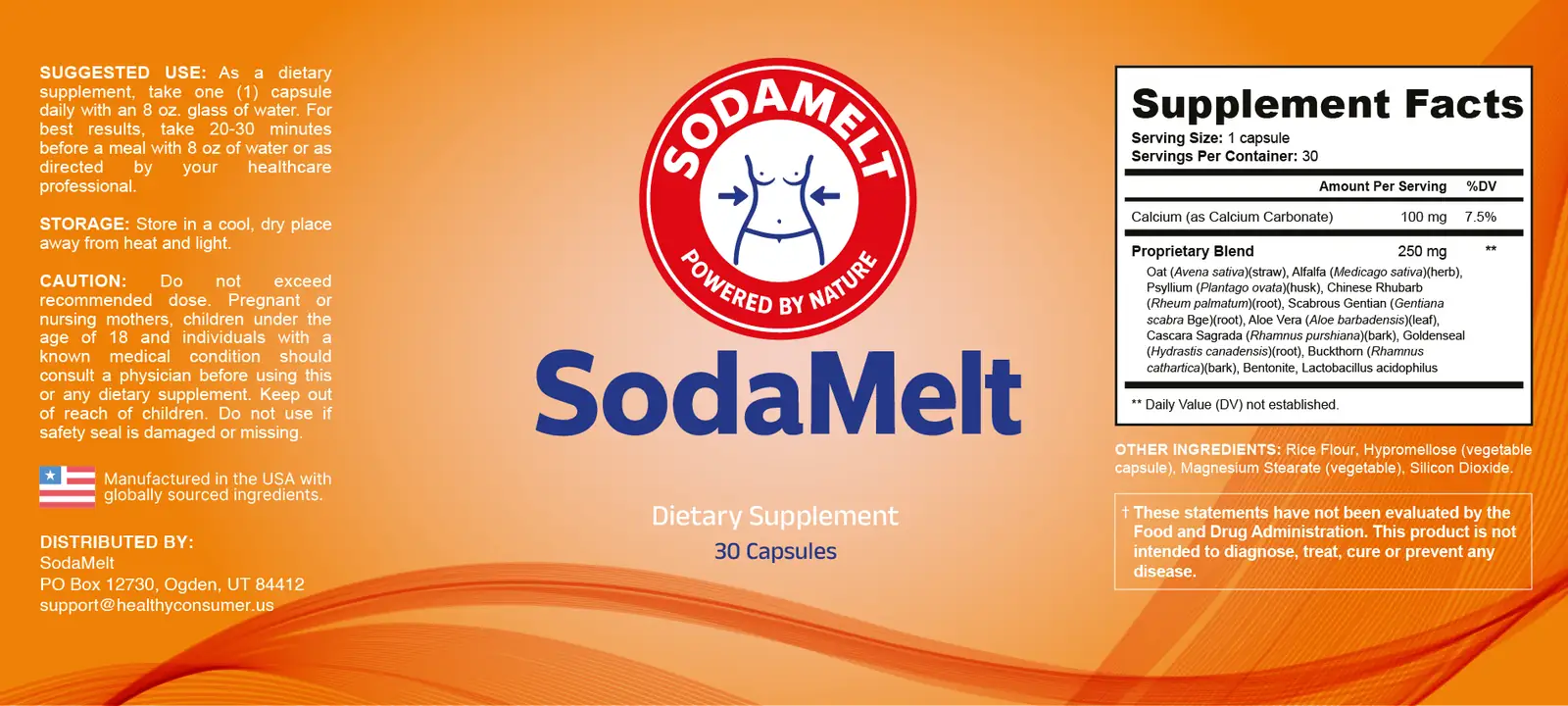
Twelve entries are named on the SodaMelt panel, and eleven of them share one 250 mg blend.
Calcium as calcium carbonate carries the only individual figure, 100 mg. The eleven run in order of weight from oat straw down to Lactobacillus acidophilus, and four of them are anthraquinone botanicals.
Every name the label prints, the plant part beside it, and what the published work used.
What does the SodaMelt label print?
Two amount lines, twelve named entries, and one of the two amounts covers eleven of them together.
| Row, as printed | Per capsule | % Daily Value |
|---|---|---|
| Calcium (as Calcium Carbonate) | 100 mg | 7.5% |
| Proprietary Blend | 250 mg | † |
Serving size one capsule, 30 servings a container. The dagger is the panel's own mark for a row with no Daily Value set. Below the panel run the inactive lines: rice flour, hypromellose (vegetable capsule), magnesium stearate (vegetable), silicon dioxide.
What are the ingredients in SodaMelt?
Twelve entries carry a name on this panel. Calcium stands alone with its own figure. The remaining eleven are botanicals, a clay and a probiotic strain, gathered into a single Proprietary Blend of 250 mg.
The cards below run in the label's own order, which is the order a blend is required to print in: descending predominance. Oat straw is therefore the largest of the eleven and Lactobacillus acidophilus the smallest, with everything else ranked between them. Each card carries the Latin binomial and the plant part the label prints, because on four of these rows the part is what decides the whole answer.
Calcium
as calcium carbonate100 mg · 7.5% DVThe only row on this bottle with a figure beside it, and the only one whose percentage can be worked backwards. Seven and a half per cent of the Daily Value puts the reference at 1,300 mg, so a capsule carries about a thirteenth of a day. Carbonate is the cheap, dense form and the one that needs stomach acid and a meal to dissolve, which is one reason the label times the capsule to a meal. How to take it covers the timing.
Oat
Avena sativa, strawfirst in the blend, so the largest shareStraw rather than grain, and the distinction decides what the row can be. The cholesterol and satiety literature everyone quotes for oats is built on beta-glucan from the groat: the 28-trial meta-analysis worked at 3.0 to 12.4 grams a day of it. Straw is the dried stem, traditionally used as an infusion and for skin, and it is not the source those trials drew on. Leading the blend means oat straw takes the biggest share of 250 mg, which is still milligrams against grams.
Alfalfa
Medicago sativa, herbsecond in the blendA forage legume with a long folk history as a spring tonic and almost no modern human trial record for digestion. What alfalfa does have is a documented signal in the other direction: L-canavanine, an amino acid concentrated in the seed and sprout, is linked in the review literature to lupus-like reactions and to flares in people who already have the condition. Herb is the aerial part rather than the seed, which lowers the exposure without making the question disappear.
Psyllium
Plantago ovata, huskthird in the blendThe one entry on this panel with a first-rank evidence base. Twelve weeks of 10 grams a day in primary care beat placebo on symptom relief, 5.1 grams twice daily outperformed docusate on stool water content and frequency, and the 2022 systematic review found the benefit sitting above 10 grams a day rather than below it. Third place in a 250 mg blend cannot reach those weights, which is why how it works treats psyllium here as identity rather than as a fibre dose.
Chinese Rhubarb
Rheum palmatum, rootfourth in the blendThe first of four anthraquinone botanicals on this panel. Rhubarb root carries emodin, the anthraquinone whose pharmacology, toxicity and kinetics have their own review, and the compound class explains the effect: anthraquinones are converted by colonic bacteria into compounds that increase motility and water secretion. The LactMed record notes the same activity is the reason the root is avoided while breastfeeding.
Scabrous Gentian
Gentiana scabra Bge, rootfifth in the blendA bitter root, and bitters are the oldest digestive idea there is: taste the bitter, and salivary and gastric secretion follows. The measured version of that effect was taken in four Siberian gentians, and Gentiana scabra is not among the four. The species has its own clinical literature, a systematic review of a G. scabra formula, and the subject there is herpes zoster rather than digestion. So the plant part and genus are right for a bitter and the species evidence points elsewhere.
Aloe Vera
Aloe barbadensis, leafsixth in the blendLeaf, and the word carries weight. The inner fillet is the gel sold for drinks and skin; the latex just under the rind is where the anthraquinone aloin sits, and aloin is the laxative. Three short randomised trials in 151 patients pooled to a benefit in irritable bowel symptoms. The 2002 FDA final rule removed aloe from the over-the-counter laxative monograph for want of safety data, a decision about OTC drugs rather than about supplements, and side effects works through what that separation does and does not mean.
Cascara Sagrada
Rhamnus purshiana, barkseventh in the blendSacred bark, and the second ingredient named in that same 2002 rule. Cascara was the most widely used stimulant laxative in American pharmacy for a century, which is also why its case reports exist: an intrahepatic cholestasis with portal hypertension after three days of a cascara product, and a LiverTox entry that keeps the record open. Bark is the correct part. The question on this row is duration rather than identity.
Goldenseal
Hydrastis canadensis, rooteighth in the blendThe row that matters most to anyone already taking something. Goldenseal is a berberine-bearing woodland root, and its human interaction work is unusually clear: Gurley's in vivo probe study measured strong inhibition of CYP3A4 and CYP2D6, a second study confirmed the 2D6 effect, and the digoxin study ran 3,210 mg a day of standardised extract. Those two enzymes clear a large share of prescription medicines. NCCIH states the concern plainly.
Buckthorn
Rhamnus cathartica, barkninth in the blendThe fourth anthraquinone source, and a genus-mate of cascara. LactMed groups R. cathartica, R. frangula and R. purshiana together for their cathartic activity and advises against use while breastfeeding. Buckthorn's own supplement trial record is thin to the point of absence; the species is named here for what it is and for the class it belongs to, and no outcome is claimed for it.
Bentonite
a volcanic claytenth in the blendAn aluminium phyllosilicate that swells in water and binds charged molecules to its surface. The research that exists is sorption chemistry: a high-capacity clay tested against aflatoxins, measured in a laboratory rather than in a person. The same surface activity that binds a toxin binds nutrients and drug molecules, which is the practical reason clays are taken away from other things. How to take it puts that in the routine.
Lactobacillus acidophilus
a probiotic strainlast in the blend, so the smallest shareProbiotics are counted in colony-forming units, and a CFU count is the figure that makes one comparable with another. The DDS-1 trial ran 10 billion CFU a day for six weeks. The outcome-specific network meta-analysis reports that strain identity decides which symptom moves, which is why a species name alone leaves the question half answered. Last position in the blend puts this entry at the smallest share of 250 mg.
Which SodaMelt ingredients are stimulant botanicals?
Four of the eleven blend entries belong to one chemical family. Chinese rhubarb root, aloe vera leaf, cascara sagrada bark and buckthorn bark all supply anthraquinone glycosides, and the family has a single well-described mechanism.
Gut bacteria cleave the sugar off the glycoside in the colon. The freed aglycone irritates the colonic wall, which raises motility and pulls water into the lumen. That is a stimulant action, and it is the same action a pharmacy senna tablet uses. Four sources of it on one panel is the single most important thing to know about this formula, and it is stated here once rather than repeated in every section.
| Entry, in label order | Plant part | The anthraquinone it is known for |
|---|---|---|
| Chinese Rhubarb (Rheum palmatum) | root | Emodin, with its own pharmacology review |
| Aloe Vera (Aloe barbadensis) | leaf | Aloin, carried in the latex under the rind |
| Cascara Sagrada (Rhamnus purshiana) | bark | Cascarosides, the classical pharmacy laxative |
| Buckthorn (Rhamnus cathartica) | bark | Frangulin and related glycosides |
Plant parts are read off the label artwork. The right-hand column names the compound class each species is known for in the pharmacognosy literature, not a measured content in this capsule.
Nothing on the bottle explains it, and there is no need to guess at a reason. What matters to a buyer is the total: four entries in one blend all pulling in the same direction, at a combined weight nobody outside the manufacturer can see. van Gorkom's review of anthranoid laxatives is the standard reference for why the class suits a short run rather than an indefinite daily habit, and side effects carries that discussion in full.
How to read the SodaMelt proprietary blend order
A proprietary blend is a legal shape, not a secret. The rule is that the ingredients inside it must be listed in descending order of predominance by weight, and the total weight of the blend must be given. Both are done here: eleven names in order, 250 mg for the lot.
That gives a reader more than it first appears. Oat straw outweighs alfalfa; alfalfa outweighs psyllium; Lactobacillus acidophilus is the smallest entry on the list. Nobody has to take that on trust, because the ordering is what the label is asserting by printing it that way.
It also sets a ceiling. Eleven entries, 250 mg between them, and an average of about 23 mg apiece if they were equal, which the ordering says they are not. The largest entry is larger than 23 mg and the smallest is smaller. Any single-ingredient comparison has to start from that arithmetic.
Honest dosage analysis: SodaMelt amounts beside the trial amounts
This is the section where the gap goes, so that the rest of the page does not have to keep mentioning it. Beside each entry is the amount the published work used, read off the abstracts themselves. The left column is what the bottle asserts. The right column is what the research ran. They are printed together because a reader can then do the comparison rather than be told the conclusion.
It is not evidence that the capsule fails, and it is not evidence that it works. A blend total sets an upper bound on every entry inside it, and for psyllium and oat that bound sits several orders of magnitude below the trial weights. For the four anthraquinone entries the comparison runs the other way: those botanicals are active at milligram quantities, which is why the class needs a duration limit rather than a minimum dose.
What else is inside a SodaMelt capsule?
Four inactive lines sit under the panel, and each one is doing an ordinary manufacturing job.
| Other ingredient | What it is there for |
|---|---|
| Rice Flour | Bulking agent. Eleven botanicals plus calcium do not fill a capsule shell on their own, so a neutral filler brings the fill weight up. |
| Hypromellose | The shell itself, a plant cellulose derivative. This is what makes the capsule suitable for a vegetarian diet rather than a gelatin one. |
| Magnesium Stearate (vegetable) | Flow agent. It keeps powder moving through the encapsulating machine without sticking. |
| Silicon Dioxide | Anti-caking agent, in the same job, keeping a hygroscopic blend from clumping. |
Read off the label artwork. The seller's own ingredient summary stops at the twelve panel entries, so these four come from the bottle.
Two of them answer questions people ask about this category. Hypromellose is the reason the capsule shell itself suits a vegetarian diet, a fact that belongs to the shell and not to the eleven botanicals inside it. Rice flour is the reason a capsule of this size can hold a 250 mg blend and 100 mg of calcium carbonate without rattling.
Which SodaMelt ingredients sit awkwardly beside a medicine?
Three mechanisms, four entries, each with a source you can open for yourself.
Goldenseal and the liver enzymes
The clearest of the three. A human probe study measured marked inhibition of CYP3A4 and CYP2D6 after goldenseal, and the critical review collects the rest. Those enzymes handle a large fraction of oral medicines, so an inhibitor raises blood levels of whatever they were clearing. This is the row to mention at the pharmacy counter.
Psyllium and absorption timing
Soluble fibre forms a gel, and a gel slows what crosses the gut wall alongside it. The conventional handling is separation in time rather than avoidance. A case report of psyllium anaphylaxis also exists, which matters to anyone who has reacted to a bulk fibre product before.
Bentonite and anything charged
The clay works by surface binding, and the surface does not distinguish between a toxin and a tablet. The sorption work is about capacity rather than selectivity. Separating a clay from other oral products by a couple of hours is the standard handling.
Calcium carbonate and the same problem
Calcium binds several drug classes in the gut and reduces their uptake. At 100 mg a capsule the exposure is modest against a dedicated calcium supplement, and the review of calcium forms covers why carbonate behaves differently from citrate.
Anyone on a prescription medicine has a single question to ask, and goldenseal is the word to bring to it. The other three are timing rather than interaction, and how to take SodaMelt puts them into a routine.
SodaMelt ingredient questions
How many ingredients are in SodaMelt?
Does SodaMelt contain baking soda?
Is SodaMelt a fibre supplement?
Which SodaMelt ingredients are laxatives?
Is the SodaMelt capsule vegetarian?
Does SodaMelt print a CFU count for its probiotic?
Sources for the SodaMelt ingredient list
Every study named above, in the order the panel lists the entry it belongs to.
- Straub DA. Calcium supplementation in clinical practice: a review of forms, doses, and indications. Nutr Clin Pract. 2007;22(3):286-96. Calcium carbonate should be taken with a meal for absorption; calcium citrate is preferred where stomach acid is low or acid-suppressing drugs are used. PMID 17507729. https://pubmed.ncbi.nlm.nih.gov/17507729/
- Whitehead A, Beck EJ, Tosh S, et al. Cholesterol-lowering effects of oat beta-glucan: a meta-analysis of randomized controlled trials. Am J Clin Nutr. 2014;100(6):1413-21. Twenty-eight RCTs at 3.0-12.4 g beta-glucan per day. PMID 25411276. https://pubmed.ncbi.nlm.nih.gov/25411276/
- Brown AC. Lupus erythematosus and nutrition: a review of the literature. J Ren Nutr. 2000;10(4):170-83. Covers the alfalfa L-canavanine reports. PMID 11070144. https://pubmed.ncbi.nlm.nih.gov/11070144/
- Gorski PM, Jurzysta M, Burda S, et al. Production and biological activity of saponins and canavanine in alfalfa seedlings. J Chem Ecol. 1991;17(6):1135-43. PMID 24259173. https://pubmed.ncbi.nlm.nih.gov/24259173/
- Bijkerk CJ, de Wit NJ, Muris JW, et al. Soluble or insoluble fibre in irritable bowel syndrome in primary care? Randomised placebo controlled trial. BMJ. 2009;339:b3154. Twelve weeks of 10 g psyllium, 10 g bran or 10 g placebo. PMID 19713235. https://pubmed.ncbi.nlm.nih.gov/19713235/
- McRorie JW, Daggy BP, Morel JG, et al. Psyllium is superior to docusate sodium for treatment of chronic constipation. Aliment Pharmacol Ther. 1998;12(5):491-7. Psyllium 5.1 g twice daily. PMID 9663731. https://pubmed.ncbi.nlm.nih.gov/9663731/
- van der Schoot A, Drysdale C, Whelan K, et al. The Effect of Fiber Supplementation on Chronic Constipation in Adults: An Updated Systematic Review and Meta-Analysis of Randomized Controlled Trials. Am J Clin Nutr. 2022;116(4):953-969. Benefit appeared only at doses above 10 g/d. PMID 35816465. https://pubmed.ncbi.nlm.nih.gov/35816465/
- Collado-Chagoya R, Hernandez-Romero J, Eliosa-Alvarado GA, et al. Plantago psyllium-secondary anaphylaxis. Case report. Rev Alerg Mex. 2018;65(1):103-107. PMID 29723946. https://pubmed.ncbi.nlm.nih.gov/29723946/
- Dong X, Fu J, Yin X, et al. Emodin: A Review of its Pharmacology, Toxicity and Pharmacokinetics. Phytother Res. 2016;30(8):1207-18. Emodin is the principal anthraquinone of Rheum palmatum. PMID 27188216. https://pubmed.ncbi.nlm.nih.gov/27188216/
- Rhubarb. Drugs and Lactation Database (LactMed). Bethesda (MD): National Institute of Child Health and Human Development; 2006-. PMID 30000922. https://pubmed.ncbi.nlm.nih.gov/30000922/
- Olennikov DN, Kashchenko NI, Chirikova NK, Tankhaeva LM. Iridoids and Flavonoids of Four Siberian Gentians: Chemical Profile and Gastric Stimulatory Effect. Molecules. 2015;20(10):19172-88. The four species studied were G. algida, G. decumbens, G. macrophylla and G. triflora, not G. scabra. PMID 26506331. https://pubmed.ncbi.nlm.nih.gov/26506331/
- Wang K, Coyle ME, Mansu S, et al. Gentiana scabra Bunge. Formula for Herpes Zoster: Biological Actions of Key Herbs and Systematic Review of Efficacy and Safety. Phytother Res. 2017;31(3):375-386. The indication studied is herpes zoster, not digestion. PMID 28078812. https://pubmed.ncbi.nlm.nih.gov/28078812/
- Hong SW, Chun J, Park S, et al. Aloe vera Is Effective and Safe in Short-term Treatment of Irritable Bowel Syndrome: A Systematic Review and Meta-analysis. J Neurogastroenterol Motil. 2018;24(4):528-535. Three RCTs, 151 patients, short-term only. PMID 30153721. https://pubmed.ncbi.nlm.nih.gov/30153721/
- Status of Certain Additional Over-the-Counter Drug Category II and III Active Ingredients. Final rule. Food and Drug Administration, HHS. 67 FR 31125, 9 May 2002; effective 5 November 2002. Aloe and cascara sagrada as OTC stimulant laxative ingredients are not generally recognized as safe and effective or are misbranded. https://www.federalregister.gov/documents/2002/05/09/02-11510/status-of-certain-additional-over-the-counter-drug-category-ii-and-iii-active-ingredients
- Nadir A, Reddy D, Van Thiel DH. Cascara sagrada-induced intrahepatic cholestasis causing portal hypertension: case report and review of herbal hepatotoxicity. Am J Gastroenterol. 2000;95(12):3634-7. PMID 11151906. https://pubmed.ncbi.nlm.nih.gov/11151906/
- Cascara. LiverTox: Clinical and Research Information on Drug-Induced Liver Injury. Bethesda (MD): National Institute of Diabetes and Digestive and Kidney Diseases; 2012-. PMID 31643443. https://pubmed.ncbi.nlm.nih.gov/31643443/
- Gurley BJ, Gardner SF, Hubbard MA, et al. In vivo effects of goldenseal, kava kava, black cohosh, and valerian on human cytochrome P450 1A2, 2D6, 2E1, and 3A4/5 phenotypes. Clin Pharmacol Ther. 2005;77(5):415-26. Twelve volunteers, 28 days of supplementation, midazolam and debrisoquine probes. PMID 15900287. https://pubmed.ncbi.nlm.nih.gov/15900287/
- Gurley BJ, Swain A, Hubbard MA, et al. Clinical assessment of CYP2D6-mediated herb-drug interactions in humans: effects of milk thistle, black cohosh, goldenseal, kava kava, St. John's wort, and Echinacea. Mol Nutr Food Res. 2008;52(7):755-63. CYP2D6 handles roughly 30% of all medications. PMID 18214849. https://pubmed.ncbi.nlm.nih.gov/18214849/
- Gurley BJ, Swain A, Barone GW, et al. Effect of goldenseal (Hydrastis canadensis) and kava kava (Piper methysticum) supplementation on digoxin pharmacokinetics in humans. Drug Metab Dispos. 2007;35(2):240-5. Standardised goldenseal at 3210 mg daily for 14 days. PMID 17079360. https://pubmed.ncbi.nlm.nih.gov/17079360/
- Mandal SK, Maji AK, Mishra SK, et al. Goldenseal (Hydrastis canadensis L.) and its active constituents: A critical review of their efficacy and toxicological issues. Pharmacol Res. 2020;160:105085. PMID 32683037. https://pubmed.ncbi.nlm.nih.gov/32683037/
- Goldenseal. National Center for Complementary and Integrative Health, National Institutes of Health. Read 19 September 2026. https://www.nccih.nih.gov/health/goldenseal
- Buckthorn. Drugs and Lactation Database (LactMed). Bethesda (MD): National Institute of Child Health and Human Development; 2006-. Updated 21 June 2021. Rhamnus cathartica, Rhamnus frangula and Rhamnus purshiana contain anthraquinones with potent cathartic properties; use should be avoided while breastfeeding. PMID 30000918. https://pubmed.ncbi.nlm.nih.gov/30000918/
- Wang M, Hearon SE, Phillips TD. A high capacity bentonite clay for the sorption of aflatoxins. Food Addit Contam Part A Chem Anal Control Expo Risk Assess. 2020;37(2):332-341. A sorption study on aflatoxins, not a trial of ingested bentonite for digestive symptoms. PMID 31790632. https://pubmed.ncbi.nlm.nih.gov/31790632/
- Martoni CJ, Srivastava S, Leyer GJ. Lactobacillus acidophilus DDS-1 and Bifidobacterium lactis UABla-12 Improve Abdominal Pain Severity and Symptomology in Irritable Bowel Syndrome: Randomized Controlled Trial. Nutrients. 2020;12(2). Three hundred and thirty adults at 1 x 10^10 CFU/day for six weeks. PMID 32019158. https://pubmed.ncbi.nlm.nih.gov/32019158/
- Xie P, Luo M, Deng X, et al. Outcome-Specific Efficacy of Different Probiotic Strains and Mixtures in Irritable Bowel Syndrome: A Systematic Review and Network Meta-Analysis. Nutrients. 2023;15(17). PMID 37686889. https://pubmed.ncbi.nlm.nih.gov/37686889/
- van Gorkom BA, de Vries EG, Karrenbeld A, Kleibeuker JH. Review article: anthranoid laxatives and their potential carcinogenic effects. Aliment Pharmacol Ther. 1999;13(4):443-52. Short-term use is generally safe; long-term use cannot be recommended. PMID 10215727. https://pubmed.ncbi.nlm.nih.gov/10215727/
Order SodaMelt with the whole panel in front of you
Twelve named entries, one capsule a day, 30 to a bottle, and 60 days from the date of purchase to change your mind.
One bottle $89 · six bottles $294 · 60-day money-back guarantee
Order SodaMelt On The Official WebsiteOne capsule a day · 30 per bottle · lot SOD-26/SO-2224