SodaMelt Official Website › Supplement Facts
Supplement FactsSodaMelt Supplement Facts
The SodaMelt panel carries two amount lines and twelve named entries.
Calcium as calcium carbonate is 100 mg, 7.5 per cent of the Daily Value. A Proprietary Blend of 250 mg holds the other eleven, printed in descending order of weight from oat straw to Lactobacillus acidophilus.
The panel reproduced, then explained: the serving, the percentage, the dagger and the blend order.
The SodaMelt Supplement Facts panel, as printed
| Row | Amount per capsule | % Daily Value |
|---|---|---|
| Calcium (as Calcium Carbonate) | 100 mg | 7.5% |
| Proprietary Blend | 250 mg | † |
Serving size: 1 capsule. Servings per container: 30. The dagger is the panel's own mark, and its footnote reads: Daily Value (DV) not established.
Two rows, and they are doing different jobs. The first is a nutrient with a reference figure behind it, so a percentage can be calculated and printed. The second is a blend, so the regulation asks for a total weight and an ordered list rather than a figure per entry.
That is why the panel looks short for a product with twelve named ingredients. The eleven names sit underneath the blend line, inside the parenthesis, in the order their weights run.
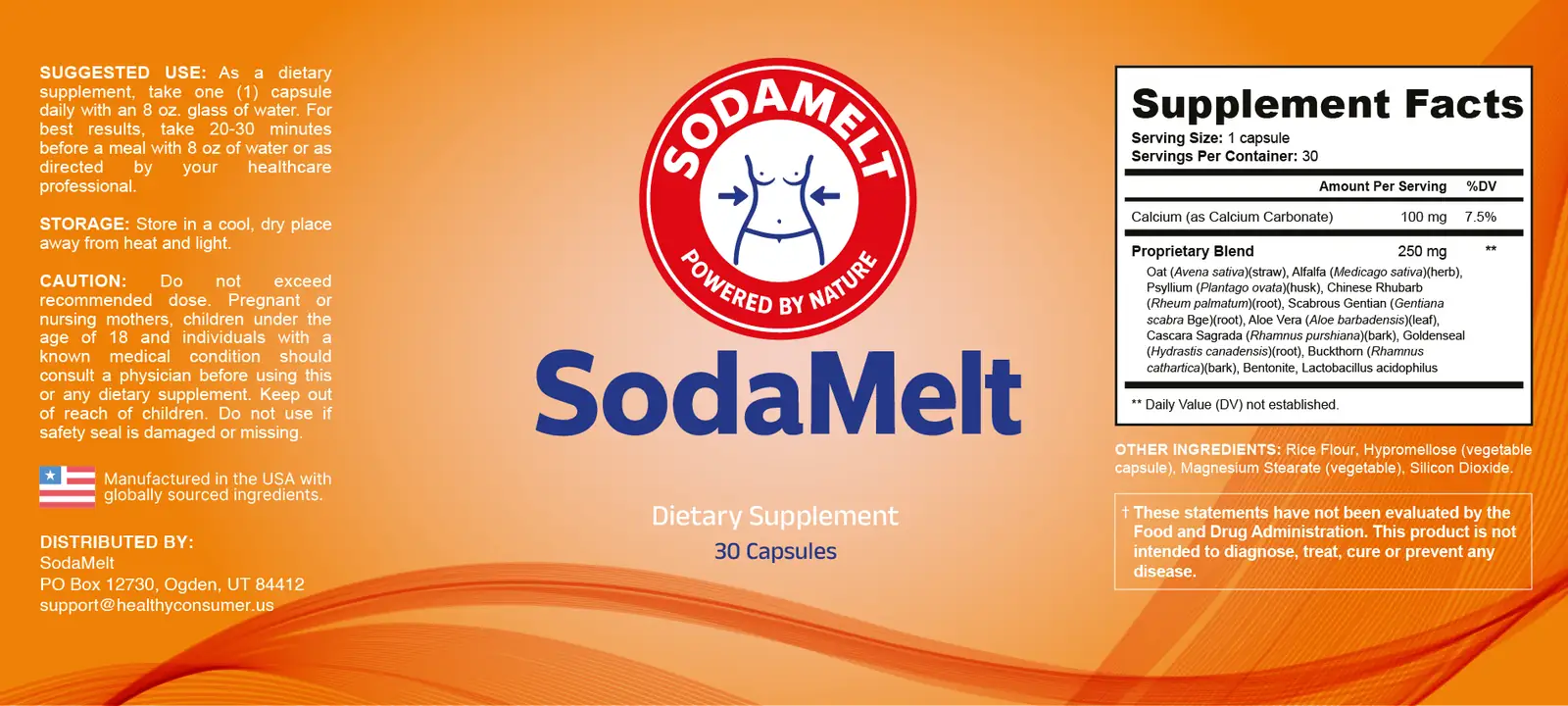
- Serving size is one capsule, and a container holds thirty of them.
- Calcium, as calcium carbonate, is 100 mg and 7.5 per cent of the Daily Value.
- The Proprietary Blend weighs 250 mg in total.
- Eleven entries sit inside that blend, each with its Latin binomial and plant part.
- The dagger footnote says the Daily Value for the blend is not established.
- Four other ingredients are listed beneath the panel, outside it.
The eleven entries in the SodaMelt proprietary blend
Printed in the order the label prints them, which is descending predominance by weight. Nothing is reordered here for readability, because the order is itself a statement the manufacturer is making.
| Rank | Entry, as printed | Latin name and plant part | What the rank tells you |
|---|---|---|---|
| 1 | Oat | Avena sativa, straw | First in the blend, so the largest share of the 250 mg |
| 2 | Alfalfa | Medicago sativa, herb | Second |
| 3 | Psyllium | Plantago ovata, husk | Third |
| 4 | Chinese Rhubarb | Rheum palmatum, root | Fourth. An anthraquinone source |
| 5 | Scabrous Gentian | Gentiana scabra Bge, root | Fifth |
| 6 | Aloe Vera | Aloe barbadensis, leaf | Sixth. An anthraquinone source |
| 7 | Cascara Sagrada | Rhamnus purshiana, bark | Seventh. An anthraquinone source |
| 8 | Goldenseal | Hydrastis canadensis, root | Eighth |
| 9 | Buckthorn | Rhamnus cathartica, bark | Ninth. An anthraquinone source |
| 10 | Bentonite | a clay | Tenth |
| 11 | Lactobacillus acidophilus | a probiotic strain | Last in the blend, so the smallest share of the 250 mg |
All eleven share one 250 mg figure. The rank column is the label's own ordering, restated, not an estimate of how much of each is present.
Two entries carry a plant part that changes their meaning entirely. Oat is straw rather than grain, so the beta-glucan literature people associate with oats belongs to a different part of the plant. Aloe vera is leaf rather than inner fillet, and the latex under the leaf rind is where the laxative anthraquinone sits.
Two more carry a species that decides the evidence. Buckthorn here is Rhamnus cathartica, the cathartic species, and gentian here is Gentiana scabra, which is not one of the four Siberian gentians in the gastric-stimulation work. All four of those distinctions are set out on the ingredients page.
How the SodaMelt serving size works
One capsule is the serving, which makes the arithmetic on this bottle unusually simple. Whatever the panel prints per serving is also what a day carries and what a capsule carries; there is no doubling, halving or dividing to do.
Thirty servings a container and one a day means a bottle is a calendar month. That is worth holding onto when reading the pack ladder, because three bottles is a quarter and six is half a year, and the pricing page runs those numbers against the cost.
What 7.5% Daily Value means on the SodaMelt panel
A percentage on a Supplement Facts panel is always measured against a published reference figure, and calcium's is 1,300 mg for adults and children of four and over. Seven and a half per cent of that is 100 mg, which is exactly the printed amount, so the two numbers agree with each other.
The form matters as much as the figure. Straub's review of calcium forms, doses and indications sets out why carbonate is the cheap dense form, around forty per cent elemental calcium by weight, and why it depends on gastric acid to dissolve, which in practice means taking it near food.
One number this site does not print is the tolerable upper intake for calcium. The government fact sheet that carries it answers automated requests with a 403, so it could not be read from a primary source in the session that built this page, and a figure nobody here opened is a figure nobody here should quote.
The dagger beside the blend points at a footnote reading “Daily Value (DV) not established”. That is a statement about the reference value, not about the ingredient. No agency has set a daily reference figure for a mixture of eleven botanicals, so there is nothing to take a percentage of. It is the standard mark on a botanical row and it appears on most panels in this category.
Other ingredients on the SodaMelt bottle
Four lines sit below the panel rather than inside it, which is the convention for materials that are there to make the capsule rather than to be in it.
- Rice Flour. The bulking agent that brings the fill weight up to a capsule's worth.
- Hypromellose. The shell itself, a plant cellulose derivative, which is what makes this a vegetable capsule rather than a gelatin one.
- Magnesium Stearate (vegetable). A flow agent, so powder moves through the encapsulating machine cleanly.
- Silicon Dioxide. An anti-caking agent, in the same job, against a blend that would otherwise clump.
The seller's own ingredient summary stops at the twelve panel entries, so these four come off the bottle artwork. They are the reason someone avoiding gelatin can take this capsule, and they are the reason the fill weight works, which is a more useful pair of facts than a list of chemical names on its own.
Where the SodaMelt pack and the bottle differ
This is stated once, here, in the section whose job it is, and it is not repeated elsewhere on the site.
The seller's own product summary prints the twelve ingredients as a flat numbered list, in alphabetical order, with calcium's amount given. Read that way, it looks like twelve discrete actives of which one has a figure.
The bottle shows a different shape. Eleven of the twelve sit inside a single 250 mg blend, and their order is weight order rather than the alphabet. Where the two disagree, the bottle governs, because the bottle is what arrives in the box.
The other difference is the dose sentence. The seller's short version is one capsule daily. The label's own version adds the 8 oz glass of water and the twenty to thirty minutes before a meal, and this site uses the label's version throughout.
| Point | The seller's summary | The printed bottle |
|---|---|---|
| Shape of the ingredient list | Twelve numbered entries | One entry with an amount, eleven inside a 250 mg blend |
| Order | Alphabetical, opening with alfalfa | Descending predominance, opening with oat straw |
| Inactive ingredients | Not covered | Rice flour, hypromellose, magnesium stearate, silicon dioxide |
| Suggested use | One capsule daily | One capsule with 8 oz of water, 20 to 30 minutes before a meal |
The right-hand column is read off the label artwork in this site's assets folder.
The caution printed on the SodaMelt bottle
“Do not exceed recommended dose. Pregnant or nursing mothers, children under the age of 18 and individuals with a known medical condition should consult a physician before using this or any dietary supplement. Keep out of reach of children. Do not use if safety seal is damaged or missing.”
Two more lines sit beside it. Storage: “Store in a cool, dry place away from heat and light.” Origin: “Manufactured in the USA with globally sourced ingredients.”
Reproducing a caution exactly is the whole discipline of a page like this one. The bottle's wording is the wording the manufacturer stands behind, and paraphrasing it would put this desk's words in place of theirs.
What this site adds to it is specificity rather than repetition. The panel's four anthraquinone entries and the goldenseal row both have named consequences, and they are set out on the side effects page rather than restated here in general terms.
How to check the SodaMelt panel against your own bottle
Read the serving size line first
One capsule, thirty servings. If the bottle in your hand says something else, every figure below it means something else too, and that is the first thing to notice rather than the last.
Check the calcium row and its percentage
100 mg and 7.5 per cent should appear together. They are two statements of the same fact, and a panel where they disagree is a panel worth photographing before anything else.
Count the names inside the blend
Eleven, in the order printed on this page. Order is the one piece of quantitative information a blend gives away, so a different order is a different product.
Read the plant parts in brackets
Straw, herb, husk, root, leaf, bark, bark, bark. Four of those brackets decide what the entry beside them can be, and they are the detail most easily missed.
Find the lot code and the best-before date
Lot SOD-26/SO-2224 is the reference this desk holds. The batch page explains what that code can be used to check and what it cannot.
If a bottle you received does not match what is on this page, the useful thing to do is photograph the panel and send it to [email protected]. A correction goes onto the page itself and moves the review date forward.
SodaMelt panel questions
What is the serving size of SodaMelt?
How much calcium is in SodaMelt?
Why does the SodaMelt panel have a dagger on it?
How much of each herb is in SodaMelt?
Does the SodaMelt capsule contain gelatin?
Is the SodaMelt blend order meaningful?
Sources for the SodaMelt panel page
The calcium reviews behind the Daily Value section, and the papers behind the four plant-part distinctions.
- Straub DA. Calcium supplementation in clinical practice: a review of forms, doses, and indications. Nutr Clin Pract. 2007;22(3):286-96. Calcium carbonate should be taken with a meal for absorption; calcium citrate is preferred where stomach acid is low or acid-suppressing drugs are used. PMID 17507729. https://pubmed.ncbi.nlm.nih.gov/17507729/
- Thomson CA, Aragaki AK, Prentice RL, et al. Long-Term Effect of Randomization to Calcium and Vitamin D Supplementation on Health in Older Women: Postintervention Follow-up of a Randomized Clinical Trial. Ann Intern Med. 2024;177(4):428-438. PMID 38467003. https://pubmed.ncbi.nlm.nih.gov/38467003/
- Whitehead A, Beck EJ, Tosh S, et al. Cholesterol-lowering effects of oat beta-glucan: a meta-analysis of randomized controlled trials. Am J Clin Nutr. 2014;100(6):1413-21. Twenty-eight RCTs at 3.0-12.4 g beta-glucan per day. PMID 25411276. https://pubmed.ncbi.nlm.nih.gov/25411276/
- Hong SW, Chun J, Park S, et al. Aloe vera Is Effective and Safe in Short-term Treatment of Irritable Bowel Syndrome: A Systematic Review and Meta-analysis. J Neurogastroenterol Motil. 2018;24(4):528-535. Three RCTs, 151 patients, short-term only. PMID 30153721. https://pubmed.ncbi.nlm.nih.gov/30153721/
- Olennikov DN, Kashchenko NI, Chirikova NK, Tankhaeva LM. Iridoids and Flavonoids of Four Siberian Gentians: Chemical Profile and Gastric Stimulatory Effect. Molecules. 2015;20(10):19172-88. The four species studied were G. algida, G. decumbens, G. macrophylla and G. triflora, not G. scabra. PMID 26506331. https://pubmed.ncbi.nlm.nih.gov/26506331/
- Buckthorn. Drugs and Lactation Database (LactMed). Bethesda (MD): National Institute of Child Health and Human Development; 2006-. Updated 21 June 2021. Rhamnus cathartica, Rhamnus frangula and Rhamnus purshiana contain anthraquinones with potent cathartic properties; use should be avoided while breastfeeding. PMID 30000918. https://pubmed.ncbi.nlm.nih.gov/30000918/
- Herbs and Supplements. MedlinePlus, U.S. National Library of Medicine. Read 19 September 2026. https://medlineplus.gov/druginfo/herb_All.html
Order SodaMelt with the panel already read
One capsule a serving, 30 servings a bottle, and 60 days from the date of purchase to change your mind.
One bottle $89 · six bottles $294 · 60-day money-back guarantee
Order SodaMelt On The Official WebsiteOne capsule a day · 30 per bottle · lot SOD-26/SO-2224