SodaMelt Official Website › How it works
How it worksHow Does SodaMelt Work?
SodaMelt carries four different mechanisms in one capsule, and they do not share an explanation.
Psyllium husk bulks and holds water. Four anthraquinone botanicals stimulate the colon, typically six to twelve hours after a dose. Bentonite binds by surface charge. One probiotic species is ranked last in the blend.
Four mechanisms, taken one at a time, each stopped where its evidence stops.
How does SodaMelt work?
A capsule this shape has four separate things going on inside it, and they do not share a mechanism. Treating them as one story is how these formulas get misread.
First, a bulking fibre that holds water. Second, four stimulant botanicals that act on the colon wall. Third, a clay that binds molecules to its surface. Fourth, a probiotic species. Calcium sits outside all four, as a mineral with its own daily reference.
Each of the four gets its own section below, and each section ends where the evidence ends rather than where the sentence would read best.
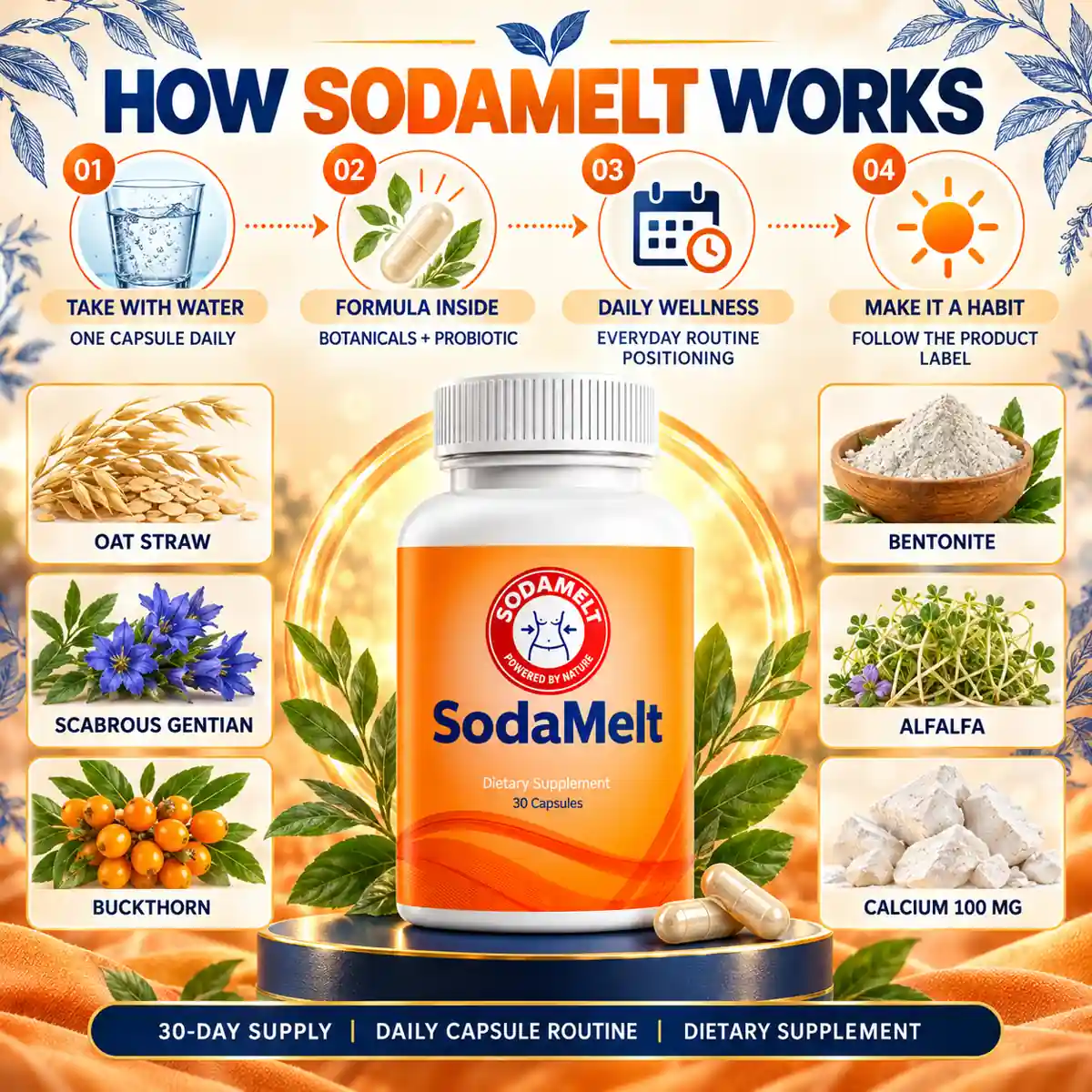
- Bulk: psyllium husk holds water and adds mass, at gram weights in the trials that established it.
- Stimulation: four anthraquinone botanicals raise colonic motility through one shared mechanism.
- Binding: bentonite clay adsorbs charged molecules onto a mineral surface.
- Colonisation: one probiotic species, ranked last in the blend.
- Calcium is separate again, a mineral with a printed Daily Value and no digestive role claimed on the panel.
The bulking route in SodaMelt: psyllium husk
Psyllium is a soluble, gel-forming fibre that resists fermentation, which is an unusual combination and the reason it behaves the way it does. It holds water through the colon rather than being eaten by bacteria on the way, so stool arrives softer and heavier.
The trial record is the strongest on this panel. Bijkerk's primary-care randomised trial ran 10 grams a day for twelve weeks against bran and placebo. McRorie compared 5.1 grams twice daily with docusate sodium and measured more stool water and more frequent movements. Chey's comparative-effectiveness trial put psyllium beside kiwifruit and prunes at 12 grams a day.
The pattern across those studies is consistent about weight. van der Schoot's 2022 systematic review reports the effect concentrating above 10 grams a day. Rao and Brenner's review of over-the-counter therapies grades psyllium at moderate evidence, which is the top of what this category offers and is still short of a drug claim.
Psyllium is third of eleven inside a 250 mg blend. The trials above are measured in grams. Bulk is a weight-dependent mechanism, which means the route is real and the quantity on this panel is not the quantity those studies used. That is the comparison, stated once, and the dosage table holds the numbers.
The stimulant route in SodaMelt: four anthraquinone botanicals
This is the route that actually moves fastest, and it is the one the panel says least about. Chinese rhubarb root, aloe vera leaf, cascara sagrada bark and buckthorn bark all deliver anthraquinone glycosides.
The glycoside passes the small intestine intact because the sugar protects it. In the colon, bacterial enzymes cut the sugar off. The freed aglycone acts on the colonic mucosa and on the enteric nerves, raising propulsive contractions and reducing water reabsorption. The result arrives six to twelve hours later, which is why a stimulant laxative taken in the evening works in the morning.
Two of these four have regulatory history attached. The FDA's 2002 final rule moved aloe and cascara sagrada out of the over-the-counter laxative monograph because the mutagenicity and carcinogenicity data the agency asked for never arrived. That rule binds drug products. A dietary supplement takes a different statutory route, which is the route this capsule takes, and the difference is a matter of which law applies rather than a finding that the ingredients changed.
| What the class does | How fast | What the literature adds |
|---|---|---|
| Raises colonic motility through bacterial activation of a glycoside | Typically 6 to 12 hours after the dose | van Gorkom's review calls long-term use unsupportable |
| Reduces water reabsorption in the colon | Same window | Explains both the effect and the fluid loss that follows overuse |
| Darkens the colonic lining with prolonged use (melanosis coli) | Months of daily use | Nascimbeni measured anthranoid use in sigmoid-cancer patients against controls |
| Acts at milligram quantities rather than gram quantities | Dose-dependent | The reason this class needs a duration limit, not a minimum |
Drawn from the anthranoid review and the epidemiological study cited below. The right-hand column reports what those papers found about the CLASS, not a measurement of this capsule.
The practical consequence is the opposite of the fibre route. Where psyllium needs grams to do anything, anthraquinones are active in milligrams, so a 250 mg blend carrying four of them is capable of a stimulant effect even though no individual weight is printed. The review that set the modern position is explicit that the class suits occasional and short-term use, and Nascimbeni's risk assessment is the study most often cited in that discussion.
The binding route in SodaMelt: bentonite clay
Bentonite is a swelling aluminium silicate clay with an enormous surface area per gram and a negative surface charge. Positively charged molecules stick to it. That is the whole mechanism, and it is a chemical property rather than a biological one.
What has been measured is capacity. Wang's sorption study tested a high-capacity bentonite against aflatoxins and reported how much it could hold. That is a laboratory measurement of binding, not a trial of a person feeling better, and no human digestive outcome trial of ingested bentonite for bloating or regularity turned up in the searches behind this site.
The useful thing to take from the chemistry is the handling rule. A surface that binds one charged molecule binds others, including minerals and drug molecules, which is why clays are conventionally taken a couple of hours away from anything else.
An adsorbent with measured capacity and no human outcome trial behind it in this use. That is a plain description, and it puts bentonite in a different position from psyllium, which has trials, and from the anthraquinones, which have a mechanism with a century of pharmacy behind it.
The probiotic route in SodaMelt: Lactobacillus acidophilus
Lactobacillus acidophilus is one of the most-studied probiotic species and one of the least specific things a label can print, because the effect belongs to the strain rather than to the species.
Martoni's randomised trial ran L. acidophilus DDS-1 alongside a Bifidobacterium at 10 billion CFU a day for six weeks and reported improvement in abdominal pain severity. The outcome-specific network meta-analysis is the paper that makes the strain point unavoidable: different strains move different symptoms, and pooling them flattens the result. A blend trial in constipated patients is the closest match to this product's own subject.
NCCIH's summary is a good plain-language starting point on where probiotic evidence is settled and where it is not.
Two things follow for this panel. The species is named, which is more than some labels manage, and the strain designation and CFU count are the two figures that would let a reader line this entry up against Martoni's trial. Ranked last of eleven inside 250 mg, the entry is the smallest share of the blend.
Where calcium sits in the SodaMelt formula
Calcium carbonate is the one row with its own number, and it is not a digestive ingredient. 100 mg is 7.5 per cent of the 1,300 mg Daily Value, which makes it a modest contribution to a mineral most people get from food.
Straub's review of calcium forms and doses sets out the practical differences: carbonate is around 40 per cent elemental calcium by weight, it is cheap and dense, and it needs gastric acid to dissolve, so it is taken with food. That requirement lines up with the label's instruction to take the capsule twenty to thirty minutes before a meal.
Calcium carbonate also has a familiar antacid use at much larger amounts, in the region of hundreds of milligrams to a gram or more of the salt per dose. This capsule is at 100 mg of elemental calcium, so an antacid effect is not something to expect from it. The Women's Health Initiative follow-up is the large trial in the background of any calcium supplementation question.
Honest critique: what the SodaMelt panel cannot tell you
Two things are outside the reach of anything printed on this bottle, and they are worth naming plainly in one place.
The first is the split inside the blend. Descending predominance fixes the order of the eleven. It does not fix the ratio, so the difference between the largest and smallest entry could be a factor of two or a factor of fifty, and both would print identically.
The second is which route is doing the work in any given person. A capsule with a bulking fibre, four stimulants, a clay and a probiotic produces one outcome, and the outcome does not say which component produced it. That is a limitation of combination products generally rather than a criticism of this one, and it is the reason the timeline page asks readers to keep a note rather than rely on impressions.
What the SodaMelt panel does well
- Twelve entries named, with Latin binomials and plant parts on all eleven botanicals.
- The blend total is given, and the order inside it is the real ordering.
- One capsule a day with a glass of water is an easy routine to keep honestly.
- The mechanisms are known ones with literature behind them, not invented pathways.
What it leaves open
- Eleven entries share one figure, so no single row can be compared with its own trials.
- Four stimulant botanicals sit in a product sold as a daily capsule.
- The probiotic has a species but no strain designation and no CFU count.
- Bentonite has sorption chemistry behind it rather than a digestive outcome trial.
Questions about how SodaMelt works
How long does SodaMelt take to work?
Does SodaMelt work by adding fibre?
Is SodaMelt a stimulant laxative?
Does SodaMelt contain anything that works on the stomach?
Sources behind the SodaMelt mechanism pages
Grouped by route: fibre first, then the anthraquinone class, then the clay, the probiotic and the mineral.
- Bijkerk CJ, de Wit NJ, Muris JW, et al. Soluble or insoluble fibre in irritable bowel syndrome in primary care? Randomised placebo controlled trial. BMJ. 2009;339:b3154. Twelve weeks of 10 g psyllium, 10 g bran or 10 g placebo. PMID 19713235. https://pubmed.ncbi.nlm.nih.gov/19713235/
- McRorie JW, Daggy BP, Morel JG, et al. Psyllium is superior to docusate sodium for treatment of chronic constipation. Aliment Pharmacol Ther. 1998;12(5):491-7. Psyllium 5.1 g twice daily. PMID 9663731. https://pubmed.ncbi.nlm.nih.gov/9663731/
- Chey SW, Chey WD, Jackson K, et al. Exploratory Comparative Effectiveness Trial of Green Kiwifruit, Psyllium, or Prunes in US Patients With Chronic Constipation. Am J Gastroenterol. 2021;116(6):1304-1312. Psyllium 12 g/d for 4 weeks. PMID 34074830. https://pubmed.ncbi.nlm.nih.gov/34074830/
- van der Schoot A, Drysdale C, Whelan K, et al. The Effect of Fiber Supplementation on Chronic Constipation in Adults: An Updated Systematic Review and Meta-Analysis of Randomized Controlled Trials. Am J Clin Nutr. 2022;116(4):953-969. Benefit appeared only at doses above 10 g/d. PMID 35816465. https://pubmed.ncbi.nlm.nih.gov/35816465/
- Rao SSC, Brenner DM. Efficacy and Safety of Over-the-Counter Therapies for Chronic Constipation: An Updated Systematic Review. Am J Gastroenterol. 2021;116(6):1156-1181. Good evidence (grade A) for polyethylene glycol and senna; moderate evidence (grade B) for psyllium. PMID 33767108. https://pubmed.ncbi.nlm.nih.gov/33767108/
- Status of Certain Additional Over-the-Counter Drug Category II and III Active Ingredients. Final rule. Food and Drug Administration, HHS. 67 FR 31125, 9 May 2002; effective 5 November 2002. Aloe and cascara sagrada as OTC stimulant laxative ingredients are not generally recognized as safe and effective or are misbranded. https://www.federalregister.gov/documents/2002/05/09/02-11510/status-of-certain-additional-over-the-counter-drug-category-ii-and-iii-active-ingredients
- van Gorkom BA, de Vries EG, Karrenbeld A, Kleibeuker JH. Review article: anthranoid laxatives and their potential carcinogenic effects. Aliment Pharmacol Ther. 1999;13(4):443-52. Short-term use is generally safe; long-term use cannot be recommended. PMID 10215727. https://pubmed.ncbi.nlm.nih.gov/10215727/
- Nascimbeni R, Donato F, Ghirardi M, et al. Constipation, anthranoid laxatives, melanosis coli, and colon cancer: a risk assessment using aberrant crypt foci. Cancer Epidemiol Biomarkers Prev. 2002;11(8):753-7. Anthranoid laxative use was 32.7% in sigmoid-cancer patients against 8.3% in controls. PMID 12163329. https://pubmed.ncbi.nlm.nih.gov/12163329/
- Wang M, Hearon SE, Phillips TD. A high capacity bentonite clay for the sorption of aflatoxins. Food Addit Contam Part A Chem Anal Control Expo Risk Assess. 2020;37(2):332-341. A sorption study on aflatoxins, not a trial of ingested bentonite for digestive symptoms. PMID 31790632. https://pubmed.ncbi.nlm.nih.gov/31790632/
- Martoni CJ, Srivastava S, Leyer GJ. Lactobacillus acidophilus DDS-1 and Bifidobacterium lactis UABla-12 Improve Abdominal Pain Severity and Symptomology in Irritable Bowel Syndrome: Randomized Controlled Trial. Nutrients. 2020;12(2). Three hundred and thirty adults at 1 x 10^10 CFU/day for six weeks. PMID 32019158. https://pubmed.ncbi.nlm.nih.gov/32019158/
- Xie P, Luo M, Deng X, et al. Outcome-Specific Efficacy of Different Probiotic Strains and Mixtures in Irritable Bowel Syndrome: A Systematic Review and Network Meta-Analysis. Nutrients. 2023;15(17). PMID 37686889. https://pubmed.ncbi.nlm.nih.gov/37686889/
- Airaksinen K, Yeung N, Lyra A, et al. The effect of a probiotic blend on gastrointestinal symptoms in constipated patients: a double blind, randomised, placebo controlled 2-week trial. Benef Microbes. 2019;10(6):617-627. Lactobacillus acidophilus NCFM at 10^10 CFU within the blend. PMID 31131616. https://pubmed.ncbi.nlm.nih.gov/31131616/
- Probiotics: Usefulness and Safety. National Center for Complementary and Integrative Health, National Institutes of Health. Read 19 September 2026. https://www.nccih.nih.gov/health/probiotics-usefulness-and-safety
- Straub DA. Calcium supplementation in clinical practice: a review of forms, doses, and indications. Nutr Clin Pract. 2007;22(3):286-96. Calcium carbonate should be taken with a meal for absorption; calcium citrate is preferred where stomach acid is low or acid-suppressing drugs are used. PMID 17507729. https://pubmed.ncbi.nlm.nih.gov/17507729/
- Thomson CA, Aragaki AK, Prentice RL, et al. Long-Term Effect of Randomization to Calcium and Vitamin D Supplementation on Health in Older Women: Postintervention Follow-up of a Randomized Clinical Trial. Ann Intern Med. 2024;177(4):428-438. PMID 38467003. https://pubmed.ncbi.nlm.nih.gov/38467003/
Order SodaMelt knowing which route does what
Four mechanisms, one capsule a day with a glass of water, and a 60-day money-back guarantee from the date of purchase.
One bottle $89 · six bottles $294 · 60-day money-back guarantee
Order SodaMelt On The Official WebsiteOne capsule a day · 30 per bottle · lot SOD-26/SO-2224