SodaMelt Official Website › Blog › Four Stimulant Botanicals
Four Stimulant Botanicals On One Panel
Cascara sagrada bark, aloe leaf, Chinese rhubarb root and buckthorn bark are four separate entries on this blend and one chemical family. They work, which is the reason they need handling rather than the reason they do not. Here is the whole record.
- Anthraquinones are stimulant laxatives. They act on the bowel wall rather than on the stool, which is a different mechanism from a bulking fibre.
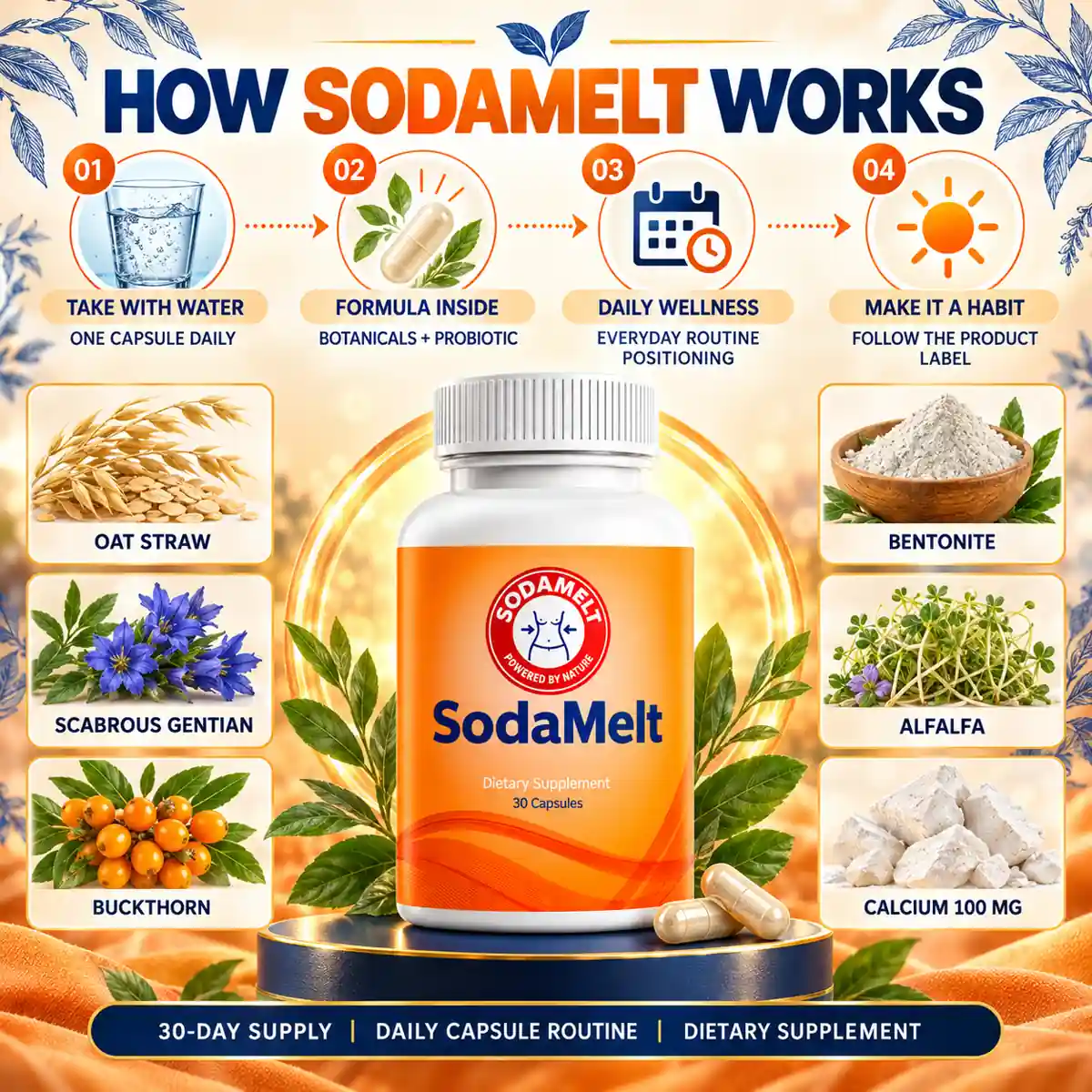
- Four of the eleven entries in this blend are anthraquinone sources: rhubarb root, aloe leaf, cascara bark and buckthorn bark.
- They are effective, and that is not in dispute anywhere in the literature.
- The standing review of the class concludes that short-term use is generally safe and that long-term use cannot be recommended.
- In 2002 the FDA removed two of these four from the over-the-counter laxative monograph for want of safety data. That rule governs drugs rather than supplements.
One family, four entries
Anthraquinones are a group of related plant compounds found across several unrelated botanical families. They have been used as laxatives for a very long time, and the plants that carry them turn up on digestion panels constantly.
What is unusual here is the count. Four separate entries on one blend come from this family, which means a reader counting ingredient names sees four different plants while a reader counting mechanisms sees one repeated.
| Entry on the panel | Plant part | Position in the blend | Where its record sits |
|---|---|---|---|
| Chinese Rhubarb (Rheum palmatum) | Root | Fourth of eleven | Emodin is its principal anthraquinone |
| Aloe Vera (Aloe barbadensis) | Leaf | Sixth of eleven | Removed from the OTC laxative monograph in 2002 |
| Cascara Sagrada (Rhamnus purshiana) | Bark | Seventh of eleven | Removed from the same monograph, same rule |
| Buckthorn (Rhamnus cathartica) | Bark | Ninth of eleven | Grouped with the other cathartic Rhamnus species |
Four separate entries from one chemical family, spread across the middle of a blend of eleven.
The pharmacology review of emodin identifies it as the principal anthraquinone of Rheum palmatum, which is the Chinese rhubarb on this panel. The LactMed record for buckthorn groups Rhamnus cathartica, Rhamnus frangula and Rhamnus purshiana together and describes them as having potent cathartic properties. Rhamnus purshiana is the cascara sagrada two rows above.
So the family membership is not an inference drawn by this desk. It is how the reference records themselves describe these plants.
How a stimulant differs from a bulking fibre
The distinction matters more than any other single fact in this post, because the two mechanisms sit on the same panel and behave completely differently.
A bulking fibre
Psyllium husk holds water. That increases the volume of stool and softens it, and the effect builds over days as the fibre becomes part of the normal transit. It is why the label insists on a full glass of water with the capsule, and why nothing dramatic happens on day one.
A stimulant anthraquinone
These act on the wall of the large bowel, prompting motility and affecting fluid handling. The effect arrives within hours rather than days, and it does not depend on anything being built up.
That difference in timing explains something people notice and misread. A blend containing both can produce a fast result, and the fast result is the stimulant half rather than evidence that a formula is well constructed.
- Bulking fibre: works with the stool, builds over days, dose-dependent in a way that has been measured in grams.
- Stimulant anthraquinone: works on the bowel wall, acts within hours, effective at small amounts.
- Together: a mixed panel where the fast effect and the researched effect come from different ingredients.
The 2002 rule, read properly
Two of these four ingredients have a regulatory history that almost no label mentions, and reporting it accurately means saying both what it was and what it was not.
| What the 2002 rule did | What it did not do |
|---|---|
| Removed aloe and cascara sagrada as over-the-counter laxative drug ingredients | Ban either plant |
| Stated that both are not generally recognised as safe and effective, or are misbranded | Apply to dietary supplements, which take a different regulatory route |
| Followed a request for mutagenicity, genotoxicity and carcinogenicity data | Make a finding that either plant causes harm |
| Took effect on 5 November 2002 | Require any supplement label to mention it |
A final rule published at 67 FR 31125 on 9 May 2002. Both columns are what it says.
The final rule was published on 9 May 2002 and took effect on 5 November 2002. The agency had earlier moved aloe and cascara sagrada into a category requiring further study, asked for mutagenicity, genotoxicity and carcinogenicity data, and did not receive it. The rule states that both are not generally recognised as safe and effective, or are misbranded, as over-the-counter drug ingredients.
The crucial limit on that is the phrase over-the-counter drug. Dietary supplements are regulated on a different route, and both ingredients remain lawful in one. A capsule sold as a supplement containing aloe leaf and cascara bark is not breaking that rule.
It is still worth a buyer knowing. A regulator asked for safety data on two ingredients, the data did not arrive, and the ingredients were withdrawn from the drug route on that basis. That is a fact about the plants rather than about the paperwork.
Read the whole SodaMelt safety page before the first capsule
Four anthraquinone entries, the 2002 rule, the liver reports and the one interaction that matters most are all set out at length on this website. 60 days from the date of purchase to change your mind.
One bottle $89 · six bottles $294 · 60-day money-back guarantee
Order SodaMelt On The Official WebsiteOne capsule a day · 30 per bottle · lot SOD-26/SO-2224
Why the time limit is the important part
Van Gorkom's review of anthranoid laxatives is the standing summary of this class and its conclusion is a pair of statements rather than a single verdict: short-term use is generally safe, and long-term use cannot be recommended.
That is an unusual shape for a safety conclusion and it is worth respecting on its own terms. It is not a warning against using these plants. It is a warning against using them indefinitely.
Nascimbeni's study put numbers to the concern that drives it. Using aberrant crypt foci as an endpoint, anthranoid laxative use was recorded at 32.7 per cent among patients with sigmoid cancer against 8.3 per cent in controls. That is an association in an observational design, not a demonstration of cause, and people who use these laxatives heavily are people with long-standing constipation, which is itself associated with the same outcome.
A defined run of weeks to a couple of months fits a formula like this one far better than an open-ended daily habit. The label sets a dose and a timing and sets no duration, which is the instruction it could most usefully have added.
The liver reports attached to cascara
Cascara sagrada carries a small hepatic literature that the other three do not, and it deserves a paragraph of its own rather than a mention in a list.
A case report describes intrahepatic cholestasis causing portal hypertension in a person taking cascara sagrada, alongside a review of herbal hepatotoxicity. The LiverTox monograph is the standing reference record for it.
Proportion matters here. These are case reports rather than trial findings, the number of people involved is very small, and cascara has been consumed by a great many people over a long period. A case report establishes that something can happen, not how often it does.
Guo and Mei's toxicity review adds the other entry worth naming: aloe vera whole-leaf extract is classified by IARC as a possible human carcinogen, Group 2B. That classification attaches to whole-leaf extract specifically, and the leaf latex is the part carrying the laxative anthraquinones.
The one group the record is unanimous about
Across every reference record for these four plants, one restriction appears without qualification.
- Buckthorn: the LactMed record says use should be avoided while breastfeeding, and groups the cathartic Rhamnus species together in saying so.
- Aloe: the same database records that aloe latex contains potent anthraquinone laxatives and should not be used during breastfeeding.
- Rhubarb: a LactMed record of its own.
- The label itself: pregnant or nursing mothers are named in the printed caution, alongside children under 18 and anyone with a known medical condition.
Four independent records and the bottle's own caution arriving at the same place is about as clear as this sort of evidence gets. It is also the single easiest thing on this page to act on.
What four of them on one panel means
Pulling the threads together, four anthraquinone entries on one blend has three consequences worth holding at once.
- The formula will do something. Stimulant laxatives are effective at modest amounts, so a fast effect is likely and is not evidence about the rest of the panel.
- It suits a defined run. The class review's own conclusion points at weeks rather than years, and a label with no stated duration leaves that decision to the buyer.
- A claim of gentleness does not survive it. A sales page describing a formula as free of harsh laxatives while the panel carries four anthraquinone botanicals is describing a different product from the one in the bottle.
That third point is why this website refuses two of the seller's own claims, which are listed with the reason beside each on the about page. A retail desk is not obliged to repeat everything the brand behind it says, and a claim the panel contradicts is the clearest case for not repeating one.
What these plants are not being accused of
The criticism above is specific, and its edges are worth marking.
- Not ineffective. The opposite: they are the most reliably effective thing on this panel, and that is the whole reason duration matters.
- Not unlawful. All four are lawful supplement ingredients, and the 2002 rule governs a different regulatory route.
- Not hidden. All four are printed on the panel with the plant part named in brackets, which is more disclosure than a good deal of this aisle offers.
- Not a reason to panic mid-bottle. Short-term use is where the reassuring half of the class review sits, and a person part-way through a first bottle is inside it.
The reasonable conclusion is narrow and unexciting. This is a formula for a defined stretch rather than a permanent fixture, the label would be better if it said so, and a buyer who knows that is a buyer making a decision rather than a guess. How to take it sets out what a sensible run looks like.
References
- Status of Certain Additional Over-the-Counter Drug Category II and III Active Ingredients. Final rule. Food and Drug Administration, HHS. 67 FR 31125, 9 May 2002; effective 5 November 2002. Aloe and cascara sagrada as OTC stimulant laxative ingredients are not generally recognized as safe and effective or are misbranded. https://www.federalregister.gov/documents/2002/05/09/02-11510/status-of-certain-additional-over-the-counter-drug-category-ii-and-iii-active-ingredients
- van Gorkom BA, de Vries EG, Karrenbeld A, Kleibeuker JH. Review article: anthranoid laxatives and their potential carcinogenic effects. Aliment Pharmacol Ther. 1999;13(4):443-52. Short-term use is generally safe; long-term use cannot be recommended. PMID 10215727. https://pubmed.ncbi.nlm.nih.gov/10215727/
- Nascimbeni R, Donato F, Ghirardi M, et al. Constipation, anthranoid laxatives, melanosis coli, and colon cancer: a risk assessment using aberrant crypt foci. Cancer Epidemiol Biomarkers Prev. 2002;11(8):753-7. Anthranoid laxative use was 32.7% in sigmoid-cancer patients against 8.3% in controls. PMID 12163329. https://pubmed.ncbi.nlm.nih.gov/12163329/
- Nadir A, Reddy D, Van Thiel DH. Cascara sagrada-induced intrahepatic cholestasis causing portal hypertension: case report and review of herbal hepatotoxicity. Am J Gastroenterol. 2000;95(12):3634-7. PMID 11151906. https://pubmed.ncbi.nlm.nih.gov/11151906/
- Cascara. LiverTox: Clinical and Research Information on Drug-Induced Liver Injury. Bethesda (MD): National Institute of Diabetes and Digestive and Kidney Diseases; 2012-. PMID 31643443. https://pubmed.ncbi.nlm.nih.gov/31643443/
- Guo X, Mei N. Aloe vera: A review of toxicity and adverse clinical effects. J Environ Sci Health C Environ Carcinog Ecotoxicol Rev. 2016;34(2):77-96. Aloe vera whole leaf extract is classified by IARC as a possible human carcinogen (Group 2B). PMID 26986231. https://pubmed.ncbi.nlm.nih.gov/26986231/
- Buckthorn. Drugs and Lactation Database (LactMed). Bethesda (MD): National Institute of Child Health and Human Development; 2006-. Updated 21 June 2021. Rhamnus cathartica, Rhamnus frangula and Rhamnus purshiana contain anthraquinones with potent cathartic properties; use should be avoided while breastfeeding. PMID 30000918. https://pubmed.ncbi.nlm.nih.gov/30000918/
- Dong X, Fu J, Yin X, et al. Emodin: A Review of its Pharmacology, Toxicity and Pharmacokinetics. Phytother Res. 2016;30(8):1207-18. Emodin is the principal anthraquinone of Rheum palmatum. PMID 27188216. https://pubmed.ncbi.nlm.nih.gov/27188216/