SodaMelt Official Website › Blog › What A Proprietary Blend Hides
What A Proprietary Blend Actually Hides
Eleven ingredients, one number. A proprietary blend is entirely lawful, very common, and the single biggest obstacle between a shopper and a comparison they could otherwise make for themselves. Here is exactly what it withholds and the one thing it still tells you.
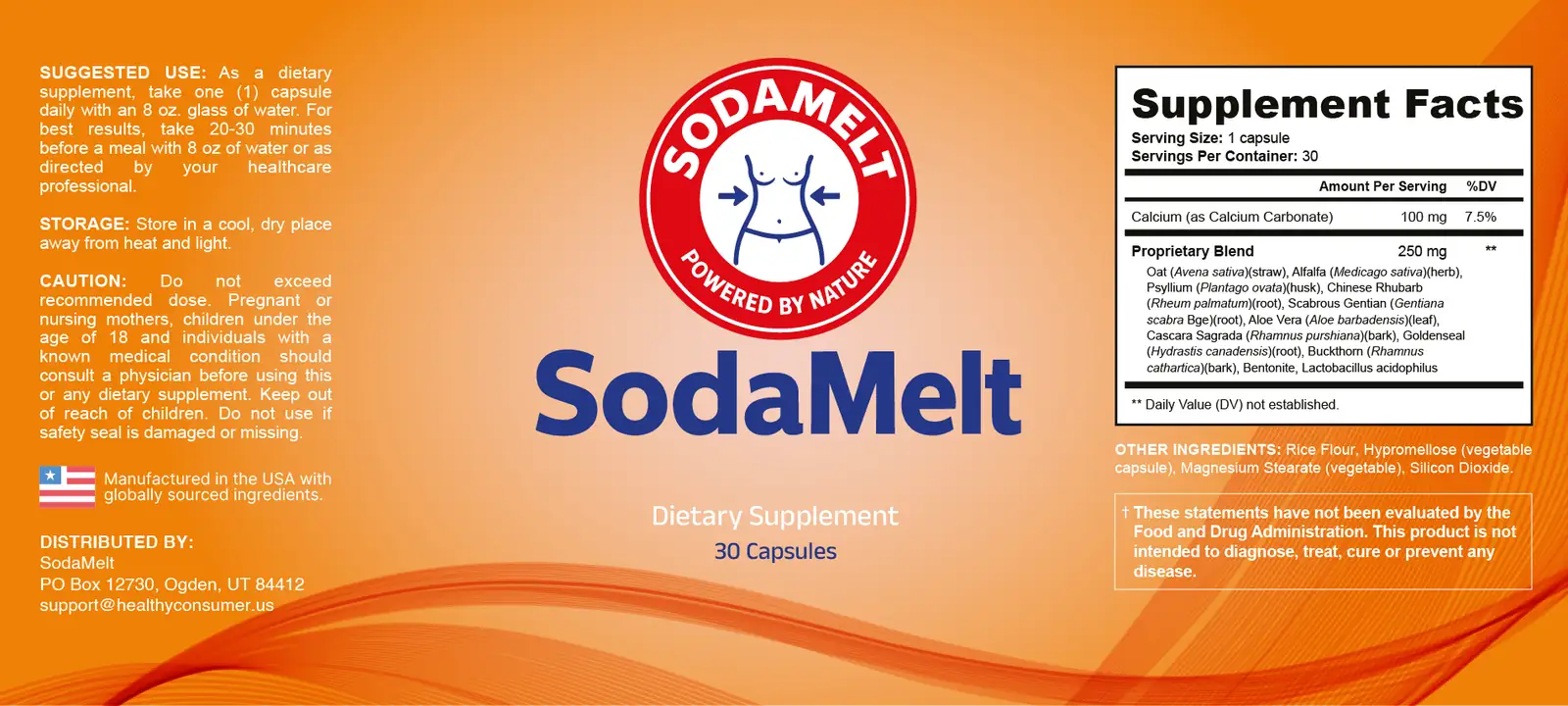
- A proprietary blend prints one total for a group of ingredients instead of an amount for each. On this panel that is 250 mg covering 11 entries.
- It is lawful, it is common, and it is usually explained as protecting a formula from being copied.
- It removes the one thing a buyer needs most: the ability to set an ingredient's amount beside the dose its own research used.
- It does leave one clue. A blend must list in descending predominance, so the first entry is the largest and the last is the smallest.
- That clue gives an order without giving a scale, which is less than it sounds and more than nothing.
What a proprietary blend is
A Supplement Facts panel normally lists each active ingredient with the amount in a serving beside it. A proprietary blend does something different: it groups several ingredients under one name, prints a single total for the group, and lists the members underneath without individual figures.
On this bottle that group is called Proprietary Blend, the total is 250 mg, and 11 ingredients sit inside it. Only one active stands outside: calcium as calcium carbonate, at 100 mg with 7.5 per cent of a Daily Value against it.
The percentage column for the blend carries a symbol rather than a number, and the footnote underneath explains that a Daily Value has not been established. That is correct labelling. There is no official reference amount for a mixture of eleven botanicals, so there is nothing to express a percentage of.
The two shapes side by side
| A transparent panel | A proprietary blend | |
|---|---|---|
| What it prints | One amount per active | One amount for a named group of actives |
| What a reader can check | Every ingredient against its own research | The total, and nothing inside it |
| What the order tells you | Nothing; the order is usually arbitrary | Descending predominance, so the first entry is the largest |
| Where the information stops | At quality and extract ratio | At the group boundary |
| How common it is in this aisle | Less common than it should be | The default, especially on long ingredient lists |
Two ways of printing the same information, and what each leaves a reader able to do.
Read the second row of that table and the whole subject is there. A transparent panel lets a reader check every ingredient against its own literature. A blend lets them check the total and stop.
Why a seller would choose one
The reason usually given is protection. A formula that prints every amount can be copied exactly by anybody with a manufacturing contract, and a company that spent money arriving at a particular ratio may not want to hand it over.
That argument has some force and it is worth stating fairly rather than sneering at. Recipes are genuinely a form of property, and a small brand in a crowded aisle has a real interest in not being duplicated by a larger one.
There is a second reason that gets mentioned less often. A blend also conceals how little of an expensive ingredient a formula contains. Both motives produce the same label, and no reader can tell from the outside which is at work.
Which means the honest position for a reader is agnostic. A blend is not proof of anything except that the information is unavailable.
What it costs the reader
Almost every useful question about a supplement is a question about quantity. Not whether an ingredient is present, but whether it is present in an amount anybody has studied.
- You cannot compare against a trial. The research behind any ingredient ran at a specific dose, and without a label figure there is nothing to set beside it.
- You cannot compare two bottles. Two products can list identical ingredients in identical order and contain wildly different amounts.
- You cannot judge value. Price per bottle is easy; price per researched dose is impossible.
- You cannot adjust. Somebody who finds a formula too strong or too mild has nothing to reason from.
- You cannot check a claim. If a sales page attributes an effect to one ingredient, the panel cannot confirm that ingredient is present in a quantity that could produce it.
That last point is the one that matters most on a long ingredient list. The more names a blend contains, the more the total has to stretch, and the more reasonable it becomes to assume that most of them are present in trace amounts.
The scale problem, in four numbers
Abstractions are easy to wave away, so here is the arithmetic with real published figures beside it.
| What the research used | What it was | The blend total, for comparison |
|---|---|---|
| 10 g a day of psyllium, twelve weeks | A primary-care trial of soluble fibre | 250 mg is the whole blend, shared eleven ways |
| Above 10 g a day of fibre | The threshold a pooled analysis found benefit above | 250 mg is about one fortieth of that figure |
| Ten billion CFU a day, six weeks | A trial of one named probiotic strain | The panel names the organism and sets no count |
| 1,300 mg | The reference figure behind a calcium Daily Value | 100 mg of calcium, printed outside the blend, is 7.5% of it |
Four published figures beside the one number this panel gives for eleven ingredients.
The Bijkerk trial ran ten grams of psyllium a day for twelve weeks. The pooled analysis that followed found the effect on chronic constipation appearing only above ten grams a day. Ten grams is ten thousand milligrams.
The entire blend on this panel is 250 mg, which is a quarter of one gram, shared between 11 entries. Even if psyllium were the whole blend, which it is not because it is listed third, it would be a small fraction of the researched amount.
The probiotic row is the same argument in a different unit. The trial of Lactobacillus acidophilus DDS-1 ran ten billion colony-forming units a day. This panel names the organism and gives no count at all, so there is not even a number to be short of.
See every SodaMelt amount beside the dose its research used
The ingredients page prints all twelve entries with the trial dose against each one, so the comparison in this post is available for the whole panel rather than four rows of it. 30 capsules a bottle, one a day, 60 days from purchase to change your mind.
One bottle $89 · six bottles $294 · 60-day money-back guarantee
Order SodaMelt On The Official WebsiteOne capsule a day · 30 per bottle · lot SOD-26/SO-2224
The one clue the rule leaves behind
A blend is not a black box with nothing written on it. Ingredients inside one must be listed in descending order of predominance by weight, which is the same rule that governs an ordinary food ingredient list.
That single requirement turns a list into information. The first name is the largest share of the total and the last name is the smallest, with everything else ranked between them.
What the order on this panel says
- Oat — First in the blend, so the largest share of the 250 mg
- Psyllium — Third
- Lactobacillus acidophilus — Last in the blend, so the smallest share of the 250 mg
Oat straw first, so it is the largest entry of the eleven. Psyllium husk third, so it is smaller than oat straw and alfalfa and larger than the eight below it. Lactobacillus acidophilus last, so it is the smallest thing in the blend.
What that does not give is scale. The first entry could be 200 mg of the 250 or it could be 40 mg, and the ordering rule is silent either way. An order without a scale is genuinely useful for ranking and genuinely useless for comparing against a trial.
The seller's own listing for this product prints the twelve ingredients as a flat numbered run starting with alfalfa, which reads as twelve separate actives in no particular order. The printed panel groups eleven of them and puts oat straw first. Where a listing and a bottle disagree about order, the bottle is the one bound by the rule.
Why one row escaped the blend
Calcium sits outside the blend with its own figure, and the reason is regulatory rather than promotional. Calcium is a nutrient with an established Daily Value, so a panel can express it as a percentage: 100 mg is 7.5 per cent of the 1,300 mg reference figure.
Botanicals have no such reference value, which is what the footnote on the blend line is saying. So the panel ends up with one row a reader can act on and one row that closes the door on eleven more.
Straub's review of calcium forms adds a practical note that the panel cannot. Calcium carbonate absorbs best with a meal, because it needs stomach acid, while citrate suits people with low acid or on acid-suppressing drugs. This label's own timing puts the capsule twenty to thirty minutes ahead of a meal, which suits the fibre rather than the carbonate.
How to read a blend without pretending
Four habits make a blend as readable as it can be, and none of them requires any special knowledge.
- Divide the total by the number of entries. It is not the real split, but it gives an average: 250 mg across 11 entries averages about 22 mg each. Hold that against a trial dose and most questions answer themselves.
- Read the order and take the top three seriously. Everything below the midpoint of a long blend is almost certainly a small amount.
- Find the best-evidenced ingredient and look up its trial dose. One comparison is usually enough to calibrate the whole panel.
- Treat the sales page as a separate document. If it attributes an effect to an ingredient sitting ninth in a blend, that is the page making a claim the panel cannot support.
Applied here, the first habit alone settles the matter. An average of a few dozen milligrams per entry against trials that ran in grams is not a close call, and the systematic review that grades over-the-counter constipation options assigns its grades to the doses those trials used rather than to ingredient names.
What a blend is not evidence of
It is easy to write about proprietary blends as though they were a trick, and that framing is unfair in three specific ways worth marking.
- Not unlawful. Blends are explicitly permitted, and a panel using one correctly, with a descending order and an accurate total, is a compliant panel.
- Not a sign of a bad formula. A well-made product can print a blend and a poor one can print every amount. The label format and the formula quality are separate questions.
- Not a claim of any kind. A blend total says nothing about what the capsule does, in either direction. It is a piece of information that has been withheld, not a statement that has been made.
What it does mean is that a buyer weighing this capsule against a transparent panel is weighing two different kinds of object. One can be checked and one has to be trusted, and the 60-day window on this product is the practical answer to being asked to trust something. It moves the cost of being wrong onto the seller for two months.
That is the honest ending. Not that a blend is a swindle, and not that it does not matter, but that it converts a question a reader could have answered into one only the manufacturer can.
References
- van der Schoot A, Drysdale C, Whelan K, et al. The Effect of Fiber Supplementation on Chronic Constipation in Adults: An Updated Systematic Review and Meta-Analysis of Randomized Controlled Trials. Am J Clin Nutr. 2022;116(4):953-969. Benefit appeared only at doses above 10 g/d. PMID 35816465. https://pubmed.ncbi.nlm.nih.gov/35816465/
- Bijkerk CJ, de Wit NJ, Muris JW, et al. Soluble or insoluble fibre in irritable bowel syndrome in primary care? Randomised placebo controlled trial. BMJ. 2009;339:b3154. Twelve weeks of 10 g psyllium, 10 g bran or 10 g placebo. PMID 19713235. https://pubmed.ncbi.nlm.nih.gov/19713235/
- Martoni CJ, Srivastava S, Leyer GJ. Lactobacillus acidophilus DDS-1 and Bifidobacterium lactis UABla-12 Improve Abdominal Pain Severity and Symptomology in Irritable Bowel Syndrome: Randomized Controlled Trial. Nutrients. 2020;12(2). Three hundred and thirty adults at 1 x 10^10 CFU/day for six weeks. PMID 32019158. https://pubmed.ncbi.nlm.nih.gov/32019158/
- Rao SSC, Brenner DM. Efficacy and Safety of Over-the-Counter Therapies for Chronic Constipation: An Updated Systematic Review. Am J Gastroenterol. 2021;116(6):1156-1181. Good evidence (grade A) for polyethylene glycol and senna; moderate evidence (grade B) for psyllium. PMID 33767108. https://pubmed.ncbi.nlm.nih.gov/33767108/
- Straub DA. Calcium supplementation in clinical practice: a review of forms, doses, and indications. Nutr Clin Pract. 2007;22(3):286-96. Calcium carbonate should be taken with a meal for absorption; calcium citrate is preferred where stomach acid is low or acid-suppressing drugs are used. PMID 17507729. https://pubmed.ncbi.nlm.nih.gov/17507729/