SodaMelt Official Website › Blog › The Glass Of Water In The Directions
The Glass Of Water In The Directions: What The Drink-Before-Meals Trials Found
The most specific sentence on the SodaMelt bottle is not about an ingredient. It is the suggested use, which names a volume of water and a window before a meal. That is unusual for the category, and it happens to match the design of published trials of drinking water before eating. This article lays the two side by side and asks which part of the routine has evidence behind it.
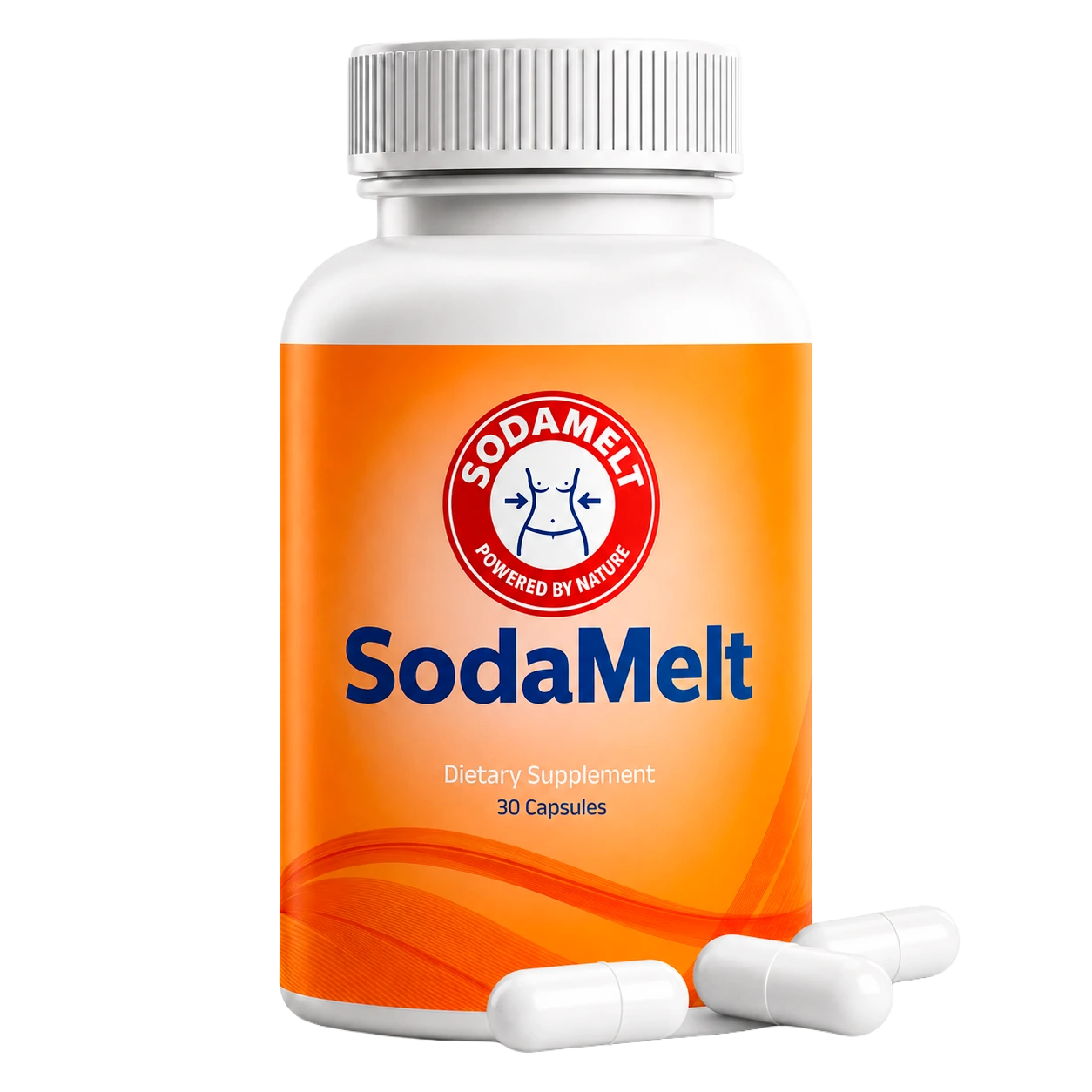
- The label says to take one capsule daily with an 8 oz glass of water, and for best results 20 to 30 minutes before a meal.
- Two randomised trials tested 500 ml of water before meals for 12 weeks, in adults who were also being helped with weight management. They reported roughly 1.3 to 2 kg more weight loss than comparison groups, with caveats.
- 8 oz is about 237 ml, under half the trials' volume, and the label asks for it once a day rather than before each meal.
- Separately, a trial in people with chronic constipation found that raising fluid intake to about 2 litres a day improved stool frequency and cut laxative use more than a high-fibre diet alone.
- The water has trial evidence. The capsule's own share of any effect cannot be separated from it, and nobody has tried.
The directions, clause by clause
The suggested use on the bottle reads: “As a dietary supplement, take one (1) capsule daily with an 8 oz. glass of water. For best results, take 20-30 minutes before a meal with 8 oz of water or as directed by your healthcare professional.” It is worth taking apart, because a lot of bottles in this category say only one daily.
There are four separable instructions in it. One capsule a day. With 8 oz of water. Twenty to thirty minutes before a meal, for best results. And a deferral to a clinician's instructions. The first is a dose. The last is a standard escape hatch. The middle two are the interesting ones, because they are not about the blend. They are about how a person behaves around a meal.
The label does not say why either clause is there. That is normal, since labels do not explain, but it leaves a reader to work out what the routine is doing. A reasonable place to look is the research on the most literal part of it: drinking a glass of water shortly before eating.
Two trials of water before meals
The design of the label's routine, water in a fixed window before a meal, is very close to the design of two randomised trials.
In the first, 48 adults aged 55 to 75 with overweight or obesity were put on a reduced-calorie diet, and one group also drank 500 ml of water before each daily meal. Over 12 weeks the water group lost about 2 kg more than the diet-alone group, a 44 percent greater decline in weight. At the start of the trial, drinking 500 ml before a test meal reduced the calories eaten at that meal, 498 against 541. At week 12, the difference was 480 against 506, which was no longer statistically significant (the trial of water before meals during a hypocaloric diet).
In the second, 84 adults with obesity from general practices in Birmingham, England, were randomised either to drink 500 ml of water 30 minutes before their main meals, or to a comparison group who were asked to imagine their stomach was full before meals. All of them had a brief weight-management consultation and a follow-up phone call. At 12 weeks the water group had lost 1.3 kg more than the comparison group (95 percent confidence interval 0.1 to 2.4 kg). After adjusting for ethnicity, deprivation, age and gender, the difference was 1.2 kg, with an interval that just crossed zero. The authors called it preliminary evidence of moderate weight loss (the trial of water preloading in adults with obesity).
Both trials are small, both were 12 weeks long, and both had the water drinkers alongside some diet or weight-management help. Neither is a trial of a capsule. What they establish is narrow but real: water drunk before meals, at a volume of 500 ml, coincided with a modest extra weight loss in those particular groups, and the effect seemed to be partly explained by eating less at the meal.
The label's water, laid beside the trials'
| Feature | The trials | The SodaMelt directions |
|---|---|---|
| Volume of water | 500 ml | 8 oz, about 237 ml |
| How often | Before each main meal | Once a day, with the capsule |
| Timing | About 30 minutes before the meal (second trial) | 20 to 30 minutes before a meal, for best results |
| Who | Adults with overweight or obesity, with diet or weight-management support | Adults aged 18 and over, no stated support |
| Duration | 12 weeks | Not stated on the bottle |
The two routines share a shape, water in a window before a meal, and differ in volume and frequency. The label's water is under half the trials' volume, taken at one meal instead of each.
Turn the volume into a daily total. If a person has three main meals a day, the trials' routine was about 1,500 ml of preload water a day. The label's routine is about 237 ml. That is roughly a sixth of the trial amount, and it is not the same routine. Nothing here means the label's version has no effect. It means the trial results cannot be read straight across to it, in either direction.
The other thing the table shows is who the trials were about. Both enrolled people with excess weight who were being helped with weight. The SodaMelt bottle prints no weight claim, and this desk does not make one. The point of the comparison is only to see what the water part of the routine has going for it.
It helps to picture the volumes. A standard small bottle of water holds 500 ml, or about 17 US ounces, so the trials' preload was one bottle before a meal. The label's 8 oz is a little under half a bottle. A person following the label to the letter is drinking about half the trials' amount, at one meal a day, with a capsule in the middle of it.
Two design details of the Birmingham trial also matter for how much weight it can bear. Its comparison group was not left alone: they were asked to imagine their stomach was full before meals, an attention control meant to separate the effect of the water from the effect of simply being asked to do something before eating. And adherence was checked with 24-hour urine collections, which is a stricter test than asking people whether they drank it. Both are marks of a careful design, and they are why the modest result is worth taking seriously, in its narrow setting.
Water and the bowel
There is a second body of research on water, and it is closer to what a capsule like this is for. In a two-month trial of 117 adults with chronic functional constipation, everyone ate a standard diet with about 25 g of fibre a day. One group drank as they pleased, and averaged 1.1 litres of total fluid a day. The other was told to drink 2 litres of mineral water, and averaged 2.1 litres. Both groups had more frequent stools and used fewer laxatives over the two months, but both effects were greater in the higher-fluid group, and the authors concluded that fibre's effect on stool frequency can be significantly enhanced by raising fluid intake to 1.5 to 2 litres a day (the trial of water supplementation with a high-fibre diet).
A 2024 systematic review of foods, drinks and diets in chronic constipation found the same direction for one type of drink. High-mineral water produced a higher response to treatment than low-mineral water in four trials, a risk ratio of 1.47 in 539 people. The review also says the whole area is short of good evidence (the review of foods, drinks and diets in chronic constipation).
Take those two together and a simple thing follows. For a person with a slow bowel, drinking more is an intervention with its own randomised evidence. It is not a side matter to the capsule, it is a competitor to it.
It also sits alongside something the panel already implies. Psyllium, at position three, is a gel-forming fibre, and fibre needs fluid to do anything. The psyllium article takes the water requirement from the fibre side. What this article adds is that the water has its own record, independent of any fibre in the blend.
Read the panel first, then decide about SodaMelt
Twelve names, one weight order, 30 capsules a bottle, and 60 days from the purchase date to change your mind.
One bottle $89 · six bottles $294 · 60-day money-back guarantee
Order SodaMelt On The Official WebsiteOne capsule a day · 30 per bottle · lot SOD-26/SO-2224
What the overlap means for attribution
Put the pieces together and an uncomfortable question appears. Suppose a buyer follows the directions exactly for a few weeks, and notices that their bowels are more regular and that they are eating a little less at the meal after the capsule. What produced that?
The candidates are the water, the timing, the stimulant plants among the eleven names, the fibre, and the ordinary effect of starting any new routine. The published trials give a specific reason to take the first one seriously: 500 ml before a meal reduced intake at that meal in one trial, and more fluid improved stool frequency in another. Neither of those effects depends on anything in a 250 mg blend.
This research found no trial that separates the capsule from the water it is taken with. Until one exists, a buyer who notices a change cannot know how much belongs to which, and this article does not claim to know either. What can be said is that the water has the evidence, and the capsule's share is unmeasured.
That matters for the seller's return window. A person deciding within 60 days whether SodaMelt works is judging a bundle of behaviours, not a blend. If the water is doing part of the work, then the honest test of the capsule is to see whether the same routine without it does the same thing. Nothing stops a reader from trying that first, since a glass of water costs nothing and carries no lot number.
The timing clause
The 20-to-30-minute window is the harder one to account for. This research found no trial that tests the timing of a capsule like this one against a meal, and the label offers no reason. What can be said is that the window matches the way water preloading was tested: the Birmingham trial gave the water 30 minutes before main meals, and a small study of a bitter herbal drop, described in this site's article on scabrous gentian, also used a 30-minute lead.
The likeliest reading is the simplest one. The window is a convention shared with the trials of pre-meal drinking, not a finding about this blend. That is an inference, and it is offered as one. The label says only for best results.
Keeping this in proportion
The trials involved specific groups and modest differences, over 12 weeks, and one of them missed statistical significance once adjusted. A kilogram or two is a real change, but it is not a transformation, and neither trial is a case for the capsule.
Anyone who has been told by a doctor to limit fluids, for any reason, should follow that advice and not a trial, and the label's own deferral to a healthcare professional applies to exactly that situation.
None of it is an accusation. The label's directions are sensible on their face. A glass of water with a capsule is what almost every supplement bottle asks for, and the pre-meal window is a common convention. What the trials add is a reason to notice that the most specific part of the routine is the part with independent evidence, and that this evidence points at the water.
Four questions for any directions that name a routine
- Which part of the routine has a trial behind it? Here it is the water, not the capsule.
- Does the volume and frequency match the trial? Here, under half the volume and once a day, not before each meal.
- Who was in the trial? Both water trials enrolled adults with excess weight who were also receiving support.
- What is the fair control? The same routine without the capsule. This research found no published trial of that comparison, and a reader can run a rough version of it before spending anything.
Those questions apply to any product whose instructions are more specific than its evidence. They are worth having, and they cost a reader a glass of water and a few minutes.
References
- Dennis EA, Dengo AL, Comber DL, Flack KD, Savla J, Davy KP, et al. Water consumption increases weight loss during a hypocaloric diet intervention in middle-aged and older adults. Obesity (Silver Spring). 2010;18(2):300-7. PMID 19661958. https://pubmed.ncbi.nlm.nih.gov/19661958/
- Parretti HM, Aveyard P, Blannin A, Clifford SJ, Coleman SJ, Roalfe A, et al. Efficacy of water preloading before main meals as a strategy for weight loss in primary care patients with obesity: RCT. Obesity (Silver Spring). 2015;23(9):1785-91. PMID 26237305. https://pubmed.ncbi.nlm.nih.gov/26237305/
- Anti M, Pignataro G, Armuzzi A, Valenti A, Iascone E, Marmo R, et al. Water supplementation enhances the effect of high-fiber diet on stool frequency and laxative consumption in adult patients with functional constipation. Hepatogastroenterology. 1998;45(21):727-32. PMID 9684123. https://pubmed.ncbi.nlm.nih.gov/9684123/
- Van Der Schoot A, Katsirma Z, Whelan K, Dimidi E. Systematic review and meta-analysis: Foods, drinks and diets and their effect on chronic constipation in adults. Aliment Pharmacol Ther. 2024;59(2):157-174. PMID 37905980. https://pubmed.ncbi.nlm.nih.gov/37905980/