SodaMelt Official Website › Blog › Scabrous Gentian
Scabrous Gentian: What The Research On This Bitter Root Actually Covers
Most rows on this panel belong to a family: four stimulant plants, one fibre, one clay, one probiotic. Scabrous gentian belongs to none of them. It is a bitter root with a long record in traditional medicine and a large laboratory literature, and it is the one name on the panel that a seller could reach for when talking about digestion or metabolism. This article reads what that literature does and does not contain.
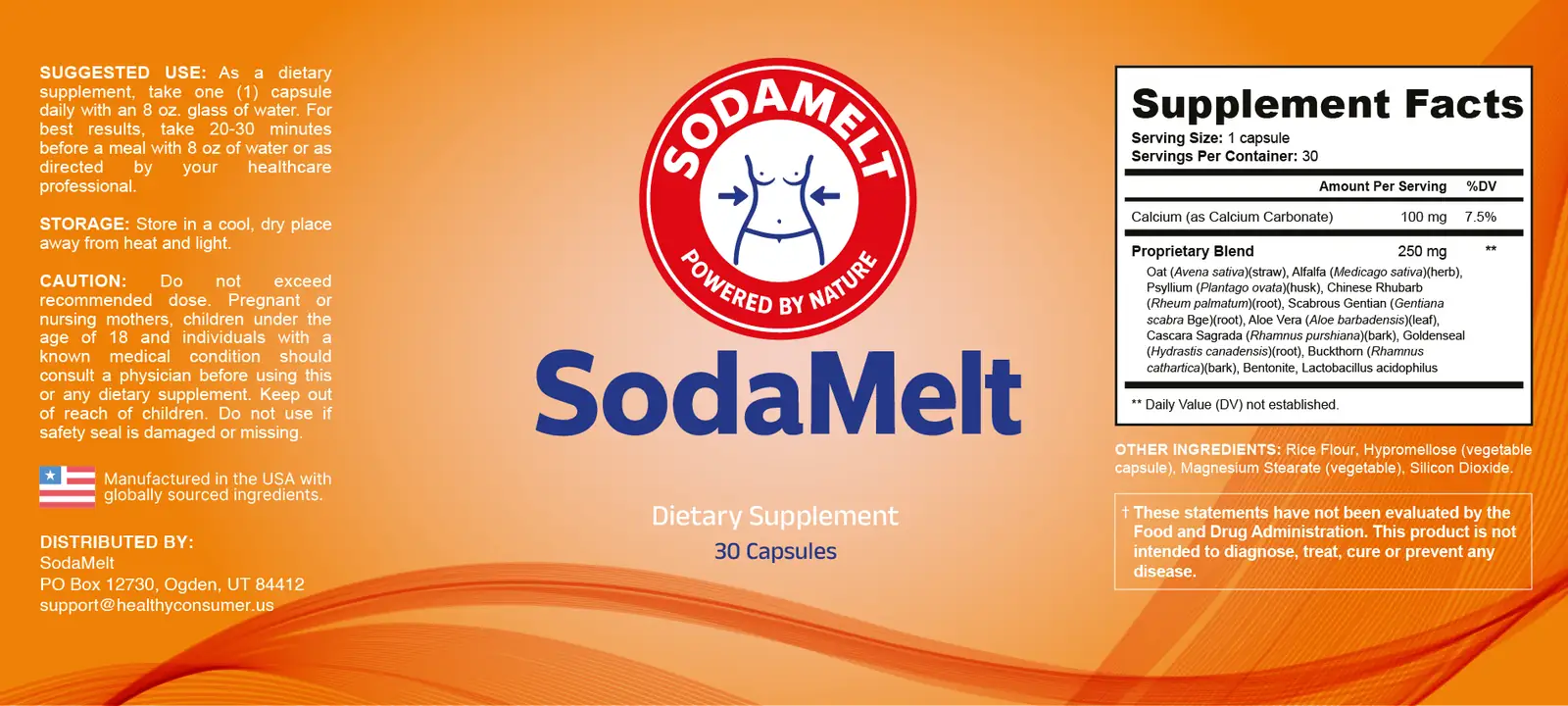
- The panel prints "Scabrous Gentian (Gentiana scabra Bge)(root)", fifth of eleven names in the 250 mg blend, with no amount for it.
- The bitter compounds are iridoid glycosides such as gentiopicroside. They are not anthranoids and they are not fibre, so this row does not share a mechanism with the rows around it.
- In the searches run for this article, PubMed returned no randomised trial of Gentiana scabra root in people. The evidence is cell work, animal work and reviews.
- The animal dose that reduced body weight in mice was 50 mg per kilogram of the purified compound. Naively scaled to an adult, that is about 3,500 mg, fourteen times the whole blend.
- In mice the compound was absorbed quickly and cleared quickly, and its authors said the data pointed to repeated dosing. The capsule is once a day.
The row that belongs to no family
Read down the printed order of the blend and the pattern is clear. Oat straw and psyllium husk are plant fibre. Chinese rhubarb, aloe, cascara and buckthorn are the four anthranoid stimulant plants. Goldenseal is an alkaloid-bearing root with an enzyme literature of its own. Bentonite is a clay and Lactobacillus acidophilus is a bacterium. Alfalfa is a forage herb. And fifth on the list, wedged between rhubarb and aloe, is Scabrous Gentian (Gentiana scabra Bge)(root).
Gentian roots are the classic bitters. Their chemistry is dominated by iridoid glycosides, of which gentiopicroside, also spelled gentiopicrin, is the best known, along with swertiamarin, loganic acid and related compounds. A 2025 review of Gentianae Radix et Rhizoma, the pharmaceutical name for the roots and rhizomes, compiled 172 constituents from the literature: 66 iridoids, 47 triterpenoids, and the rest other terpenoids, flavonoids, lignans and alkaloids (the review of the chemistry and pharmacology of Gentianae Radix). It names Gentiana scabra among the main source species, alongside G. rhodantha, G. manshurica and G. veitchiorum.
That last point is a small credit to the label. The pharmaceutical drug comes from several Gentiana species, and this panel says which one. Gentiana scabra Bge is a specific plant with a specific literature, and the abbreviation after the name is the author citation that pins down which botanist's definition of the species is meant.
What tradition and the laboratory say
The traditional use of gentians is as bitters: teas and tinctures taken to stimulate appetite and ease dyspepsia. A study of four Siberian gentians, none of them G. scabra, records that nomadic people used them as bitter teas or appetizers to relieve digestive disorders such as dyspepsia, heartburn and nausea. In the authors' laboratory assays the decoctions stimulated acid-, enzyme- and mucin-forming functions of the stomach, which they attributed mainly to iridoids and flavonoids (the study of four Siberian gentians and gastric stimulation).
Notice what that is and is not. It is a laboratory measurement on gentians related to, but not the same as, the one on this panel. It supports the idea that bitter iridoid-rich roots act on the stomach, and it says nothing about a capsule.
The nearest thing to a human study is small and mixed. Twenty-four patients with long-standing dysmotility-type functional dyspepsia, all negative for Helicobacter pylori, took 20 drops of a hydro-alcoholic solution before meals for two weeks. The solution was a compound of four herbs: gentian, cinchona, wormwood and cinnamon. Gastric emptying, measured by a paracetamol absorption test, and a global symptom index both improved (the study of a four-herb bitter in functional dyspepsia). It is a positive result, in a small group, for a four-herb liquid, and its authors do not say which of the four did what. It cannot be assigned to gentian alone, and it certainly cannot be assigned to a root powder in a capsule.
The dyspepsia study gave its drops 30 minutes before meals. The SodaMelt label's suggested use says to take the capsule 20 to 30 minutes before a meal. The label does not say why, and this article does not claim the two are connected. Traditional bitters are simply commonly taken ahead of eating, so the resemblance is unsurprising.
The metabolic work, and its size
The seller's phrase everyday metabolic wellness has to attach to something, and gentian is the row where laboratory work exists that a person could point to. It deserves a fair reading.
In one study, an extract of Gentiana scabra root stimulated secretion of glucagon-like peptide-1 in human enteroendocrine cells in a dish, dose-dependently, and lowered blood glucose in diabetic db/db mice through that route. The authors traced part of the effect to a bitter iridoid glycoside, loganic acid, and noted the plant is prescribed in traditional Korean medicine for diabetes (the study of Gentiana scabra extract and GLP-1). In another, purified gentiopicroside reduced fat storage in cultured fat cells, and in mice fed a high-fat diet for 12 weeks, 50 mg per kilogram of body weight by mouth resulted in lower body weight and less visceral fat than the controls (the study of gentiopicroside and adipogenesis in mice).
Those are the results a marketing page would love to borrow. They are also mouse results, on a purified compound or a research extract, at a dose given per kilogram.
| Quantity | What it is | Where it comes from |
|---|---|---|
| 50 mg per kg | Purified gentiopicroside, by mouth, in mice | The obesity study |
| About 3,500 mg | The same figure, naively multiplied by a 70 kg adult | Arithmetic, not a valid dose conversion |
| 250 mg | The entire SodaMelt blend, eleven names | The Supplement Facts panel |
| 22.7 mg | The even split of the blend, per name | Arithmetic on the panel |
Body-weight scaling between mice and people is not a simple multiplication, so the second row is only a sense of scale. It shows the direction of the gap, not its exact size.
Even on that generous arithmetic, the whole capsule is about a fourteenth of the mouse dose and the even-split gentian share is about a hundred and fiftieth of it, and that is before allowing for the fact that the mouse dose was the purified compound and a root powder is mostly other material. Nothing about this row makes the metabolic phrase reachable at 250 mg.
See the SodaMelt panel exactly as printed
Two rows, eleven names inside one of them, every Latin binomial and plant part on the label. One capsule a day with a full glass of water.
One bottle $89 · six bottles $294 · 60-day money-back guarantee
Order SodaMelt On The Official WebsiteOne capsule a day · 30 per bottle · lot SOD-26/SO-2224
Bitter is a taste, and a capsule has none
The tradition behind gentian is a tradition of taste. A bitter tea or tincture is drunk, tasted and expected to prompt the digestive response that bitterness prompts. A capsule has no taste, so a natural question is whether the idea survives the delivery format.
The laboratory work suggests it might, for a reason that is not about the tongue. The authors of the GLP-1 study state that they had previously reported that intestinal bitter taste sensation stimulates GLP-1 secretion, and their whole hypothesis is that the extract's bitter iridoids act on enteroendocrine cells in the gut, which they tested in a human cell line. If bitter compounds act on the intestine itself, a capsule that releases them there is not obviously handicapped.
That is a hypothesis with cell and mouse support. It also brings the amount question straight back, because a cell in a dish gets a defined concentration and a gut gets whatever fraction of a small dose is released and absorbed. Nothing on the panel says what that is.
Same species, different content
There is one more reason the row is hard to pin down, and it is about the plant, not the label. Chemists have compared the gentiopicroside content of Gentiana scabra root collected in different seasons and in different growing years (the comparison of gentiopicroside content by season and growing year). More recently, a group sampled the rhizosphere soil of G. scabra from six producing areas in one Chinese province and examined how soil microorganisms and environmental factors relate to gentiopicroside content in the roots and rhizomes, sorting the samples into high-content and other groups (the study of soil, environment and gentiopicroside content in Gentiana scabra).
The lesson is a general one about botanicals. A Latin name fixes the species, not the content. Two lots of the same species can differ in their marker compounds depending on where and when the root was grown and harvested, and a label that prints only the species cannot tell a reader which of those lots it holds.
Fifth of eleven
Under the federal rule for blends, 21 CFR 101.36, the ingredients are listed in descending order of weight. Gentian is fifth of eleven, above aloe, cascara, goldenseal, buckthorn, bentonite and the probiotic, and below oat straw, alfalfa, psyllium and rhubarb. Four names sit above it, which would make it a mid-sized share of a small total. The even split is 22.7 mg. The proprietary blend article works through what that ordering does and does not tell a reader.
Fifth place is the position a seller can point to when saying the row is there at a meaningful level, and it is also the position at which the numbers above still leave the amount short of any dose the research used. Both of those things are true together, which is what a blend allows.
Absorption, and why once a day matters
There is a further detail about the compound, and it comes from a pharmacokinetic study. In mice, gentiopicroside was absorbed rapidly after an oral dose, with a peak at about half an hour, and cleared quickly, with an oral half-life of about 2.8 hours. Its oral bioavailability was 39.6 percent. The authors concluded that the data show the need for repeated dosage, or better, a slow-release formulation (the mouse pharmacokinetics of gentiopicroside).
That is a mouse study, and half-lives do not transfer directly between species. But its direction is worth noting alongside the label, which asks for one capsule a day. If a bitter iridoid is cleared within hours, a single daily dose gives a short exposure, and there is no slow-release feature described on the panel. The four stimulant botanicals article covers the rows on this panel that do have a plausible reach.
Safety, and the honest absence of alarm
This is the one row on the panel where the safety literature is quiet, and it should be reported as quiet. An updated review of gentiopicroside states that studies indicate low toxicity, while adding that long-term toxicity and oral bioavailability still need to be worked out (the review of gentiopicroside's pharmacological activities). Nothing turned up in this research suggests a specific medicine interaction or a group who should avoid the root, which is a contrast with goldenseal, alfalfa and the four stimulants. A reader concerned about safety should worry about other rows first.
That is not the same as a clean bill of health. Quiet can mean well studied and safe, or it can mean barely studied, and for a root with so little human research the second is at least as likely. The bottle's own caution still applies in full.
What is missing
The review mentioned above says that clinically, the purified compound has been applied in conditions including herpes zoster and non-alcoholic fatty liver disease. That is a statement about gentiopicroside, not about the root, and this research did not verify the underlying trials. What it did find, running PubMed searches on the Latin name and on trial terms, was no randomised trial of Gentiana scabra root in people, at any dose.
The gap is the finding. A reader can hold three separate facts at the same time. The root has a genuine traditional use and a substantial laboratory literature. The doses behind the laboratory work are far above what a share of a 250 mg capsule can deliver. And the human trial evidence for the root itself, as opposed to a compound or a mixture, was not found.
What this is not an accusation of
This is not a claim that gentian does nothing, and it is not a claim that it is unsafe. It is an old bitter with a real chemistry. It is not a claim that the panel is misleading either. The row prints a species and a plant part, which is more than a lot of labels do, and it makes no claim about what the row is for.
What the article does say is narrower and checkable. Every route by which gentian could contribute to a benefit runs through amounts the panel does not print. Every study that gives a number gives one far larger than the capsule can hold. And the one thing a buyer can do to narrow the unknowns is ask for the certificate of analysis for the lot, which the batch verification page explains how to do.
Four questions for any bitter-root row
- Which species, and is it the one that was studied? Gentians are a large genus, and the Siberian, Chinese and European species have different literatures.
- Root, or something else? Root and rhizome carry the iridoids the research measures. This panel says root.
- Studied in people, or only in dishes and mice? Here, the latter.
- At what dose? If the answer is per kilogram of body weight, multiply by your own weight and compare it with the panel before believing the connection.
Those four questions cost a reader ten minutes, and they work on the next bottle, whichever botanical is on its list.
References
- Liu H, Liu X, Liu S, Zhao F. The chemical structure, pharmacological activity, and clinical progress of Gentianae Radix et Rhizoma. Front Pharmacol. 2025;16:1656493. PMID 41194879. https://pubmed.ncbi.nlm.nih.gov/41194879/
- Olennikov DN, Kashchenko NI, Chirikova NK, Tankhaeva LM. Iridoids and Flavonoids of Four Siberian Gentians: Chemical Profile and Gastric Stimulatory Effect. Molecules. 2015;20(10):19172-88. PMID 26506331. https://pubmed.ncbi.nlm.nih.gov/26506331/
- Metugriachuk Y, Marotta F, Kuroi O, Tsuchiya J, Goh KL, Minelli E, et al. Effect of a phyto-compound on delayed gastric emptying in functional dyspepsia: a randomized-controlled study. J Dig Dis. 2008;9(4):204-7. PMID 18959591. https://pubmed.ncbi.nlm.nih.gov/18959591/
- Suh HW, Lee KB, Kim KS, Yang HJ, Choi EK, Shin MH, et al. A bitter herbal medicine Gentiana scabra root extract stimulates glucagon-like peptide-1 secretion and regulates blood glucose in db/db mouse. J Ethnopharmacol. 2015;172:219-26. PMID 26129938. https://pubmed.ncbi.nlm.nih.gov/26129938/
- Choi RY, Nam SJ, Lee HI, Lee J, Leutou AS, Ri Ham J, et al. Gentiopicroside isolated from Gentiana scabra Bge. inhibits adipogenesis in 3T3-L1 cells and reduces body weight in diet-induced obese mice. Bioorg Med Chem Lett. 2019;29(14):1699-1704. PMID 31130265. https://pubmed.ncbi.nlm.nih.gov/31130265/
- Lu YR. [Comparison of the gentiopicroside content and preparation of the root of Gentiana scabra collected in different seasons and in different growing years]. Zhong Yao Tong Bao. 1986;11(5):42-4. PMID 2944662. https://pubmed.ncbi.nlm.nih.gov/2944662/
- Hou J, Yin H, Wang D, Luo J, Yang W, Kang T. The influence of rhizosphere soil microorganisms and environmental factors on gentiopicroside content in the roots and rhizomes of Gentiana scabra Bunge from Liaoning Province. Front Microbiol. 2025;16:1554981. PMID 40182295. https://pubmed.ncbi.nlm.nih.gov/40182295/
- Wang CH, Wang ZT, Bligh SW, White KN, White CJ. Pharmacokinetics and tissue distribution of gentiopicroside following oral and intravenous administration in mice. Eur J Drug Metab Pharmacokinet. 2004;29(3):199-203. PMID 15537172. https://pubmed.ncbi.nlm.nih.gov/15537172/
- Ding Y, Gou X, Wu X, Tao Y, Wang Y, Wang Y, et al. Gentiopicroside: An Updated Review of Its Pharmacological Activities and Mechanisms. Chem Biodivers. 2024:e202402306. PMID 39714353. https://pubmed.ncbi.nlm.nih.gov/39714353/